

Chess tempo and initiative are two of the most misunderstood concepts in the game - yet mastering them is what separates players who constantly react from players who dictate the flow of every game. In this guide, you will learn exactly what tempo and initiative mean in practical chess, how to gain them, how to keep them, and how to convert that positional pressure into real wins at every stage of the game.
What Exactly Is Chess Tempo and Why Does It Matter So Much?
In chess, a tempo is simply one move - one unit of time. Gaining a tempo means you accomplish something useful while forcing your opponent to waste a move, giving you a lead in development, space, or activity. The player with more tempos effectively gets to act while the other reacts.
Think of a chess game as a race. Both players are building their armies, activating their pieces, and preparing attacks. Every move is a precious resource. If you can force your opponent to move the same piece twice, or make a pointless defensive move, you have stolen one move's worth of time from them and used it to improve your own position. Over the course of an opening and middlegame, these stolen moments compound into a massive advantage.
The classic example: after 1.e4 e5 2.Nf3, White attacks the e5-pawn. If Black plays 2...Nc6 to defend, both sides have developed a piece. But if Black plays something passive like 2...f6?, White plays 3.Nxe5 and wins a pawn. Black wasted a tempo on a move that did not develop a piece or improve the position - White punished that immediately.
"The winner of the game is the player who makes the second-to-last mistake." - Savielly Tartakower. But the player with the initiative decides when mistakes happen.
Tempo vs. Material: Which Is More Valuable?
Players often sacrifice small amounts of material specifically to gain tempos. A pawn gambit like the King's Gambit (1.e4 e5 2.f4) offers a pawn in exchange for rapid development and a lead in tempos. The theory is simple: with enough extra tempos, you can build a decisive attack before your opponent organizes a defense. This is not reckless - it is a calculated trade of material for time.
- At beginner level, one tempo is often worth 0.3-0.5 pawns of positional value
- In sharp tactical positions, a single tempo can mean the difference between winning and losing immediately
- In slow positional games, tempo advantages compound more gradually but still decisively
Pro tip: Every time you move a piece for the second time in the opening without a clear reason, ask yourself - could my opponent use that tempo to develop another piece or strengthen their position? If yes, you are probably losing tempos unnecessarily.
What Is the Initiative in Chess and How Is It Different from Tempo?
The initiative in chess is the right to attack - it means your opponent is forced to respond to your threats rather than create their own. While tempo is about individual moves, the initiative is the broader, ongoing state of who is dictating the flow of the game.
You can have the initiative without having an immediate material advantage. A player with active, well-placed pieces making constant threats holds the initiative even if the position is technically equal on the board evaluation. The player without the initiative is permanently on defense, burning their own tempos just to stop your ideas.
The Three Pillars of the Initiative
- Piece activity: Your pieces must be on aggressive squares where they create real threats. A bishop on f4 pressuring d6 is active. A bishop on d2 waiting around is passive.
- Threat continuity: One threat is easy to parry. Continuous threats - especially threats that gain material or checkmate - force your opponent into an endless defensive posture.
- King safety imbalance: If your king is safe and your opponent's king is exposed, you naturally hold the initiative because every attack you launch carries real danger.
Tempo is the currency; the initiative is what you buy with it. Spend your tempos wisely in the opening to purchase the initiative, then use that initiative to create threats your opponent cannot simultaneously answer.
How Do You Gain Tempo in the Opening Phase of Chess?
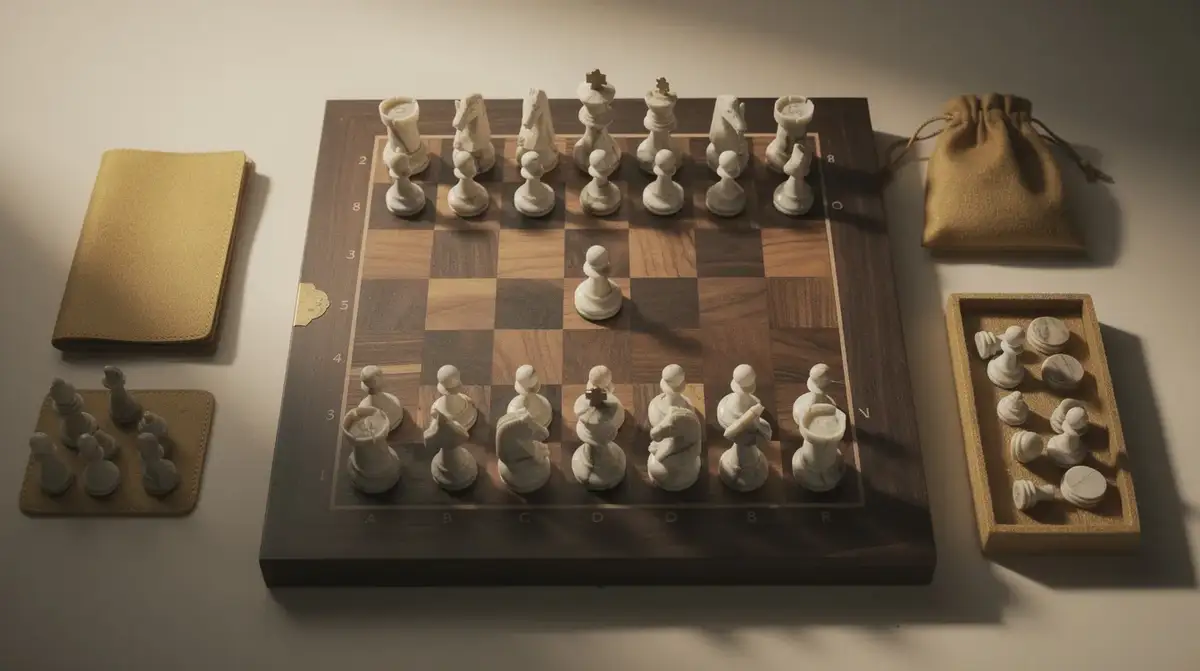
You gain tempo in the opening by developing your pieces to active squares quickly, controlling the center, and making threats that force your opponent to respond instead of developing their own pieces. The classical opening principles exist precisely to maximize tempo efficiency.
The Golden Rules of Opening Tempo
- Develop knights before bishops: Knights need more moves to reach the center, so get them there first with Nf3 and Nc3 (or Nf6 and Nc6 for Black).
- Castle early: Castling connects your rooks and removes the king from danger in one move - highly efficient tempo usage.
- Never move the same piece twice without a concrete reason: Each unnecessary repeat move is a free tempo gift to your opponent.
- Attack pieces that need to retreat: If you develop a piece that attacks an opponent piece, they burn a tempo defending or moving it away.
- Use pawn moves sparingly: Pawns do not develop pieces. Too many early pawn moves create tempo losses because you are not building your army.
A perfect example of opening tempo exploitation is the Ruy Lopez (1.e4 e5 2.Nf3 Nc6 3.Bb5). White immediately puts pressure on the knight defending e5. Black must spend moves responding to this threat, while White continues developing. Every response Black makes is at least partially defensive - White has seized the initiative from move 3.
Compare that to the Giuoco Piano (1.e4 e5 2.Nf3 Nc6 3.Bc4). White still develops rapidly but without immediate pressure on Black's position. Black can develop freely. Both moves are fine, but Bb5 creates an immediate tempo problem for Black that Bc4 does not.
Common trap: Many beginners fall into the Scholar's Mate pattern (early queen development) thinking they are gaining tempo by threatening checkmate quickly. In reality, if your opponent defends correctly, your queen gets chased around the board by developing pieces, and you lose multiple tempos while your opponent gains free development. Early queen moves almost always cost more tempo than they gain.
Want to see these opening ideas in practice? Our openings explorer lets you browse thousands of opening lines with real move probabilities so you can understand exactly which moves create tempo advantages and which ones waste them.
How Do You Keep and Extend the Initiative Once You Have It?
You keep the initiative by making threats that are more dangerous than the concessions required to meet them, forcing your opponent to constantly react rather than create counterplay of their own. The moment you stop making threats, your opponent breaks free and seizes the initiative themselves.
Practical Methods for Sustaining Pressure
The most effective way to maintain the initiative is through threat chaining - each move you make creates a new threat even as the previous one is being addressed. This is the engine behind famous attacking players like Mikhail Tal and Paul Morphy. They did not just make one big threat and wait. They made threat after threat, each one building on the last.
- Double attacks and forks: A knight fork on f7 attacks king and rook simultaneously. Your opponent can only deal with one, and you take the other. Use our chess puzzles and tactics trainer to drill fork patterns until they become instinctive.
- Discovered attacks: Moving one piece to reveal an attack from another is devastating because two threats appear in one move. This is pure initiative - your opponent cannot stop both.
- Pins and skewers: These restrict your opponent's freedom of movement, which is another form of maintaining the initiative. A pinned piece cannot participate in counterplay.
- Open files for rooks: Rooks on open or semi-open files generate constant pressure. Every rook move can be a tempo-gaining threat against a pawn or weak square.
- Pawn breaks: A well-timed pawn break like d5 in the King's Indian or c5 in the Sicilian creates new threats and open lines, injecting fresh initiative when the position might otherwise stabilize.
The player who makes threats wins. The player who only answers threats loses. Your goal in every game is to be the one setting the agenda, not responding to it.
When Should You Sacrifice Material to Maintain Initiative?
Material sacrifices to maintain the initiative are justified when the resulting activity of your pieces creates threats that cannot all be answered at once. The classic standard: if sacrificing a pawn means your opponent's king is exposed, your pieces all become active, and you can generate at least 3-4 consecutive threats, the sacrifice is almost certainly sound.
Pro tip: Before sacrificing material for the initiative, count how many moves your attack can sustain. If you can see 4 or more forcing moves in a row - where every one of your moves creates an immediate threat - the sacrifice is very likely correct. If the attack fizzles after 2 moves, hold back.
How Do You Reclaim the Initiative When You Are on Defense?
You reclaim the initiative from a defensive position by creating immediate counterplay - usually through a pawn break, a tactical shot, or a piece sacrifice that opens new lines and generates threats your opponent must address. Passive defense almost never works at intermediate level and above.
The key principle here is active defense. There is a massive difference between defending with a move that only defends, and defending with a move that also threatens something. The second type of defense forces your opponent to make decisions of their own, which slows their attack and gives you breathing room.
Three Classic Counterplay Patterns
- The flank counterattack: While your opponent attacks on the kingside, launch your own attack on the queenside. Chess is not checkers - threats on one wing can neutralize threats on the other. The classic Dragon Sicilian is built on this exact principle.
- The tactical resource: Study positions carefully when under pressure. There is often a fork, pin, or sacrifice lurking that completely changes the evaluation. This is why practicing tactics daily makes you a better defensive player, not just a better attacker.
- The positional pawn break: Sometimes the right defensive move is actually a pawn advance that opens lines for your own pieces. In the King's Indian Defense, Black's ...d5 or ...f5 breaks are not just attacks - they are responses that neutralize White's space advantage and create genuine counterplay.
The best defense in chess is often a well-timed counterattack. If you can make a defensive move that simultaneously threatens something dangerous, you force your opponent to shift from attacking mode to defensive mode - and you reclaim the initiative in one stroke.
Playing against our human-like chess bots is one of the best ways to practice holding the initiative under pressure. Each bot plays with a distinct personality - the Attacking Bot will constantly press you to defend accurately, while the Defensive Bot will challenge you to break through solid defensive setups.
What Are the Most Common Tempo Mistakes That Club Players Make?
The most common tempo mistakes club players make are developing the queen too early, making unnecessary pawn advances in the opening, retreating pieces when attacked instead of counterattacking, and failing to castle before launching middlegame operations. These mistakes give opponents free development and the initiative.
Mistake 1 - Moving Pieces Without Threats
Every developing move should ideally control important squares, support a pawn, or create a threat. Moving a piece to a square where it does nothing active is a wasted tempo. Before playing any developing move, ask: does this piece do something useful right now, or am I just parking it somewhere safe?
Mistake 2 - Chasing Ghosts
Many players spend tempos defending against threats that do not actually exist. Before defending, calculate whether the threat is real. If your opponent plays Ng4 threatening to take on f2, check concretely - can they actually execute the threat? Can you ignore it and play your own attack? Sometimes the best response to a threat is to make a bigger counter-threat rather than defend.
Mistake 3 - The Passive Retreat
When a piece is attacked, the instinctive reaction is to retreat it. But a retreat is often a wasted tempo because you moved that piece there in the first place, and now you are undoing that move. Instead, look for ways to counterattack, defend the piece with another piece that develops naturally, or sacrifice the piece if it gives you initiative in return.
Mistake 4 - Delaying Castling Too Long
Every move you delay castling leaves your king vulnerable and prevents your rooks from connecting. Your opponent can exploit this by opening the center - once the center is open, a king stuck in the middle becomes a target that consumes multiple tempos to defend. Castle within the first 8-10 moves in most positions.
Common trap: Do not confuse activity with aggression. Moving a piece to an aggressive-looking square that can be immediately chased away is a tempo loss. Aggression must be backed by calculation. If your opponent can simply play a developing move that attacks your aggressive piece, you will end up losing the tempo you thought you were gaining.
How Do Tempo and Initiative Apply Differently in the Middlegame and Endgame?
In the middlegame, tempo and initiative primarily relate to piece activity and attacking threats; in the endgame, tempo becomes a precise mathematical concept where a single move can determine whether a pawn promotes or not, and opposition determines which king controls key squares. Both phases require tempo consciousness, but the application changes dramatically.
Middlegame Initiative - Attacks and Piece Coordination
In the middlegame, the initiative is measured in threats. A player who can generate threats on moves 18, 19, 20, and 21 while their opponent is purely defending on each of those moves has total initiative. The middlegame initiative often culminates in tactical explosions - sacrifices that open the king, combinations that win material, or mating nets that the opponent walks into because they had no counterplay.
Use the AI bot learn mode to practice middlegame positions where you are on the attacking side. The interactive AI will show you how to build initiative move by move, highlighting the key moments where threats can be escalated.
Endgame Tempo - The Opposition and Zugzwang
In king and pawn endgames, tempo is often the entire game. The concept of opposition - two kings facing each other with one square between them - determines who controls the key squares. The player who does NOT have to move (who has the opposition) wins the battle of tempos.
Even more powerful is zugzwang - a position where any move you make worsens your own position. In endgames, creating zugzwang is often the entire winning technique. A single wasted tempo in a king and pawn endgame can turn a won position into a draw, and a drawn position into a loss.
- In king and pawn vs. king endgames, the attacker often needs to lose a tempo (triangulate) to reach the desired position with the opponent to move
- In rook endgames, the Lucena and Philidor positions are entirely based on tempo management
- In minor piece endgames, bishop vs. knight imbalances often depend on who can use tempos to restrict the opponent's piece
Tempo awareness never turns off. It evolves from "am I developing faster than my opponent?" in the opening, to "am I generating more threats than I am defending against?" in the middlegame, to "can I control whose turn it is to move in this critical position?" in the endgame.
Sharpening your endgame tempo skills is best done through dedicated practice. Our endgame training module covers 30+ classic positions across three difficulty tiers, with a specialized endgame AI bot that will challenge your tempo calculation in critical king and pawn positions.
Frequently Asked Questions About Chess Tempo and Initiative
How many tempos is a pawn worth in the opening?
A tempo has no fixed pawn value: its importance depends on whether the position is forcing. In open positions, a lead in development can justify a gambit because it creates immediate threats; in quiet positions, the extra pawn may remain more important.
Can you have the initiative with less material?
Yes, absolutely. A player down a pawn but with active, coordinated pieces and a strong attack on the enemy king can absolutely hold or even dominate the initiative. In fact, the attacking player in a sacrificial combination often has less material but completely controls the game because every one of their pieces is making a threat the opponent must answer.
How do I know when to give up the initiative and consolidate?
Give up the initiative and consolidate when the material advantage you have gained is large enough to win without further attacking play, when your opponent has organized a solid defense that cannot be broken through, or when continuing the attack would require sacrificing too much material without clear compensation. Grandmasters switch between attacking and consolidating based on the concrete position, not general principles.
Does playing faster on the clock help maintain initiative?
In timed games, playing with confidence and reasonable speed can put psychological pressure on your opponent, but tempo in the chess sense has nothing to do with clock time. A slow, thoughtful move that creates a devastating threat gains chess tempo even if it costs clock time. However, time pressure does cause players to make tempo-losing moves out of panic, so managing both types of "tempo" is important in competitive play.
What is the difference between the initiative and a direct attack?
The initiative is broader than a direct attack. You can have the initiative in a purely positional game where no direct attack exists - your pieces are simply more active, you control more space, and your opponent is cramped and reactive. A direct attack is one specific form of initiative that specifically targets the king or creates immediate tactical threats.
Understanding chess tempo and initiative is not about memorizing rules - it is about developing a feel for whose pieces are active, who is making threats, and who is being forced to react. Start every game by asking: am I developing with purpose? Am I creating threats? Am I forcing my opponent to respond to me? Practice these ideas against challenging AI opponents, drill tactical patterns that generate initiative, and review your games to spot where tempo was lost or gained. The player who controls the tempo controls the game - and now you know exactly how to be that player.
The fastest way to build tempo instincts is through focused practice. Try our game analyzer to review your recent games and pinpoint exactly where you lost or gained initiative. You can input any game in PGN format and get move-by-move feedback on missed tactics and tempo-wasting decisions. Combined with daily work on our chess puzzles and tactics trainer, you will develop the pattern recognition that makes tempo and initiative management feel natural and automatic within just a few weeks of consistent training.