

Every chess player reaches a point where they feel stuck. You know the basic rules, you can see a few moves ahead, but winning feels random. Games slip away because of one missed tactic or a confusing endgame. The good news is that getting better at chess follows a clear path — and anyone can walk it with the right approach.
This guide breaks down the most effective ways to improve at chess, from your first 100 games to breaking past the 1200–1500 rating range. No fluff, no "just play more" advice. Concrete steps you can start using today.
Why Most Beginners Stop Improving
The most common mistake beginners make is playing game after game without studying. Playing is essential, but it only reinforces the patterns you already know. If you keep making the same mistakes — hanging pieces, missing forks, playing random openings — more games just cement those bad habits.
Common trap: Playing 10 blitz games a day feels productive, but without review you are just repeating the same errors faster.
Real improvement happens when you combine three types of practice:
- Pattern recognition — solving tactics puzzles to spot threats instantly
- Knowledge building — learning opening principles and endgame techniques
- Deliberate play — playing focused games and reviewing your mistakes afterward
At the beginner level, 70% of your time should go to tactics, with the remaining 30% split between openings, endgames, and reviewed games. This ratio shifts as you improve, but tactics always remain the foundation.
Step 1: Master Chess Tactics First
Tactics are short-term combinations that win material or deliver checkmate. The most common patterns you need to recognize instantly:
Forks
A fork is when one piece attacks two or more enemy pieces at the same time. Knight forks are the most common and most dangerous because knights can jump over other pieces. The classic scenario: your knight lands on a square that simultaneously attacks the king and a rook. Your opponent must save the king, and you capture the rook for free.
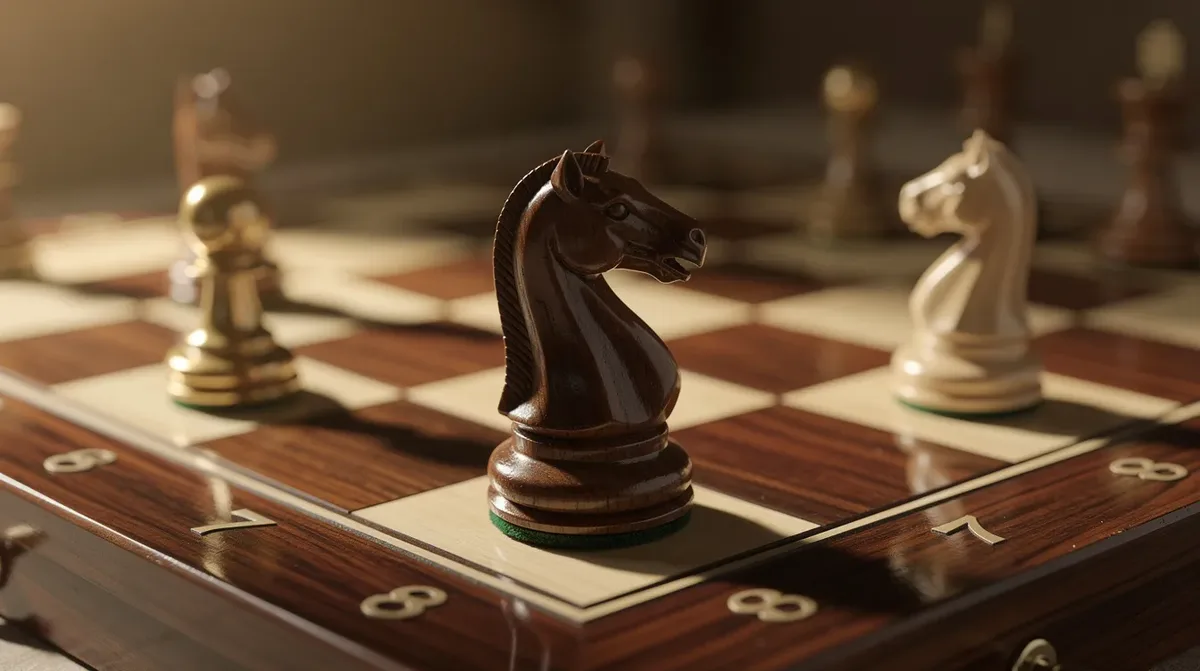
But forks are not limited to knights. Queens, bishops, and even pawns can create devastating forks. The key is learning to scan every position for double-attack possibilities.
Pins and Skewers
A pin locks an enemy piece in place because moving it would expose a more valuable piece behind it. A skewer is the reverse — you attack a valuable piece that must move, exposing a less valuable piece behind it. Both of these are line-based tactics that exploit piece alignment along ranks, files, and diagonals.
Back-Rank Mates
When a king is trapped behind its own pawns on the first or eighth rank, a single rook or queen on the back rank delivers checkmate. This pattern wins more games at the beginner level than any other tactic. Always ask yourself: is my opponent's back rank safe?
How to Train Tactics Effectively
Pro tip: Instead of solving random puzzles, practice forks for a week until you spot them automatically. Then move to pins. Then discovered attacks. Themed training builds deep pattern libraries that fire instantly during games.
Our chess puzzles and tactics trainer organizes puzzles exactly this way — by category. You can focus on forks, pins, skewers, back-rank mates, sacrifices, deflections, discovered attacks, or trapped pieces. Each puzzle has a three-level hint system if you get stuck: first the target square, then a visual arrow, then the full solution.
Step 2: Learn Opening Principles, Not Memorized Lines
Beginners often waste months memorizing specific opening moves without understanding why those moves are played. Here is what actually matters in the opening:

The Four Golden Rules
- Control the center — place pawns on e4/d4 (or e5/d5 as black) and point your pieces toward the center squares
- Develop your pieces — get knights and bishops off the back rank and into active positions within the first 10 moves
- Castle early — tuck your king to safety before the middlegame fight begins
- Do not move the same piece twice in the opening unless there is a concrete tactical reason
Once you understand these principles, you can play any opening reasonably well. The specific moves matter less than the ideas behind them.
When to Start Learning Specific Openings
Once you are consistently applying the four rules and your rating passes roughly 1000, it makes sense to learn 2–3 openings as white and a system against 1.e4 and 1.d4 as black. Keep it simple. The openings explorer shows move probabilities and ECO classifications so you can see which lines humans actually play.
Step 3: Do Not Ignore Endgames
Most beginners avoid studying endgames because they seem boring compared to flashy middlegame tactics. This is a massive missed opportunity. Endgame knowledge is the most reliable way to convert good positions into wins and save bad positions into draws.

Essential Endgames Every Player Must Know
- King and pawn vs. king — understanding the opposition and when a pawn promotes
- Rook endgames — the Lucena and Philidor positions that appear in one out of four games
- Queen vs. pawn on the seventh rank — surprisingly tricky positions that often decide games
- Basic checkmates — king + queen vs. king, king + rook vs. king (you must be able to do these reliably)
Our endgame training section has 30+ classic positions organized into three difficulty tiers. The endgame challenger bot runs on its own specialized neural network trained specifically on endgame positions — it will test your technique ruthlessly.
Step 4: Play Against Opponents That Teach You
Not all practice games are equal. Playing against opponents that challenge your specific weaknesses is far more valuable than random matchmaking.
Here is what different types of opponents teach you:
- Aggressive opponents force you to learn defensive technique, recognize threats, and stay calm under pressure
- Defensive opponents teach you to build plans, maintain patience, and find breakthroughs in solid positions
- Positional opponents show you the importance of pawn structure, piece placement, and long-term strategy
Why it matters: This is exactly why human-like chess bots with distinct personalities are so effective. The Attacking Bot throws everything at you, the Defensive Bot makes you prove you can break through, and the Practical Hunter grinds out small advantages. Each one is powered by a custom-trained neural network built from real human games.
Step 5: Review Every Serious Game
After playing a game, spend 5–10 minutes reviewing it before starting the next one. Focus on:
- Where did the game turn? Find the move where the evaluation shifted significantly
- What did I miss? Look for tactics you overlooked — both yours and your opponent's
- Was my opening plan reasonable? Did you follow opening principles or did you waste tempo?
- How was my time management? Did you think when it mattered and move quickly when the position was clear?
The game analyzer lets you paste any PGN and see every move classified as best, good, inaccuracy, mistake, or blunder. It detects missed tactics with visual arrows directly on the board, so you can see exactly what you overlooked.
Step 6: Build a Consistent Training Routine
Improving at chess is not about marathon sessions. 30 minutes of focused daily practice beats a 4-hour weekend session. Here is a simple routine that works:
Daily (30 minutes)
- 15 minutes: Solve 10–15 themed tactics puzzles
- 10 minutes: Play one game with a specific focus (for example, "I will castle before move 10 in every game this week")
- 5 minutes: Quick review of your game — find your worst move and understand why it was bad
Weekly (1 extra hour)
- 20 minutes: Study one endgame type (for example, rook endings this week)
- 20 minutes: Walk through a new opening line in the explorer and play a practice game using it
- 20 minutes: Deeper review of your best and worst game from the week
Common Mistakes That Slow Your Progress
Playing only bullet and blitz
Speed chess is fun but teaches bad habits. You do not have time to calculate or think deeply, so you rely on instinct — which is unreliable when your pattern database is still small. Play at least some longer games (15+10 or 30-minute) where you actually have time to think.
Studying advanced openings too early
Learning the Najdorf Sicilian when you regularly hang pieces is a waste of time. Your opponent will play a random move on move 5 and your entire preparation is useless. Focus on principles first, specific lines later.
Never analyzing your own games
This is the number one growth killer. If you do not review your games, you will keep making the same mistakes. Even a quick 2-minute scan after each game helps.
Only playing weaker opponents
Winning feels good, but you learn the most from challenging games. Play against opponents who are slightly stronger or who have a style that exposes your weaknesses.
How AI Tools Accelerate Your Improvement
Modern chess training with AI offers something human coaches cannot provide: instant, unlimited, and personalized feedback on every single move. Here is how to use AI training tools effectively:
- Live commentary during games — instead of just seeing "mistake" after the game, you get real-time explanations of why a move was bad and what tactical element you missed
- Themed puzzle training — AI-organized puzzles by tactical theme build deeper pattern recognition than random puzzle sets
- Human-like opponents — AI bots trained on human games give you a more realistic practice experience than traditional engines
- Game analysis — post-game review tools show you exactly where you went wrong with visual aids
Use AI tools actively, not passively. Try to guess the best move before looking at the answer. Active recall is what builds lasting pattern recognition.
Setting Realistic Improvement Goals
Chess improvement is not linear. You will have plateaus where nothing seems to work for weeks, followed by sudden jumps. This is normal.
Realistic timelines with consistent daily practice:
- Complete beginner to 800 — 1–2 months of learning rules and basic tactics
- 800 to 1200 — 3–6 months of daily puzzles, opening principles, and basic endgames
- 1200 to 1500 — 6–12 months of deeper tactical training, specific openings, and game analysis
- 1500 to 1800 — 1–2 years of strategic understanding, advanced endgames, and pattern mastery
These timelines assume 30 minutes of focused daily practice. More time speeds it up, less time slows it down. The critical factor is consistency over intensity.
Start Today: Your First Chess Improvement Session
Do not overthink it. Right now, pick one of these and spend 15 minutes:
- Solve 10 fork puzzles in the tactics trainer
- Play one game against the Practical Hunter bot with live commentary on
- Practice king and pawn endgames in the endgame trainer
Whichever you choose, you have taken the first step. The rest is just showing up every day and putting in focused work.