

Chess tactics are the engine of improvement for every player rated between 800 and 1800. If you want to win more games, stop blunders, and spot combinations your opponents miss, then sharpening your tactical vision is the single most effective thing you can do. This guide covers every major tactical theme, gives you a proven daily training structure, and shows you exactly how to practise so that patterns stick for good.
What Are Chess Tactics and Why Do They Matter More Than Strategy?
Chess tactics are short sequences of moves - usually 1 to 5 moves deep - that win material, deliver checkmate, or achieve a decisive positional gain through forcing moves such as checks, captures, and threats. While strategy is the long-term plan, tactics are the concrete tools that cash in on that plan.
Grandmaster Savielly Tartakower captured this perfectly:
"The blunders are all there on the board, waiting to be made." Every unprotected piece, every overloaded defender, every exposed king is a tactical opportunity - for you or against you.
At the amateur level, strategic understanding rarely separates players. What separates a 900 from a 1400 is almost entirely tactical awareness. The 1400 player spots the fork on move 12 before committing to a line. The 900 player walks into it. That is the whole difference.
Tactics matter because:
- They decide the outcome of most games at the club level immediately and concretely
- Tactical patterns are trainable - unlike intuition, they can be drilled into memory
- Spotting tactics defensively is just as important as finding them offensively
- A single tactic can reverse a completely lost position in one move
If you want to improve your chess rating as quickly as possible, prioritise tactical training above everything else. Openings and endgame theory matter, but tactics pay dividends from your very next game.
What Are the Most Important Tactical Patterns Every Player Must Know?
The most important tactical patterns are forks, pins, skewers, discovered attacks, back-rank mates, deflections, decoys, and trapped pieces. These eight themes account for the vast majority of tactical opportunities in real games.
Forks - Attacking Two Pieces at Once
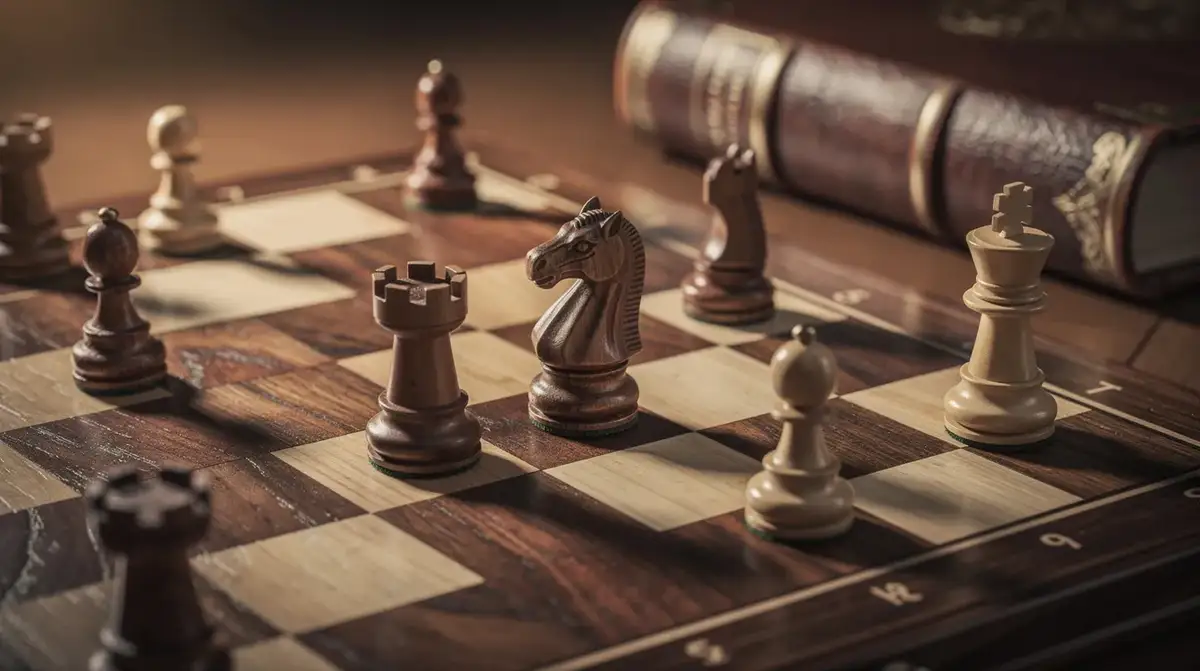
A fork occurs when one piece attacks two or more enemy pieces simultaneously, forcing the opponent to lose material because they can only save one. The knight fork is the most famous example. After 1.e4 e5 2.Nf3 Nc6 3.Bc4, beginners often fall into 3...Nd4?? allowing 4.Nxe5 followed by Nxd4, winning a pawn for nothing. Knight forks on the f7 square are particularly deadly in the opening because they attack the king and rook simultaneously.
Pins - Restricting a Piece That Shields a More Valuable Target
A pin immobilises a piece because moving it would expose a more valuable piece behind it to capture. An absolute pin freezes a piece that shields the king - moving that piece is literally illegal. A relative pin means moving the piece is legal but would cost material. Learning to exploit pins by piling attackers onto the pinned piece is one of the highest-value skills in chess.
A relative pin can sometimes be broken when the move creates a stronger forcing threat. The interactive Legal's mate lesson shows how to test the opponent's checks before taking an exposed queen.
Skewers - The Reverse Pin
A skewer attacks a valuable piece that must move, exposing the less valuable piece behind it. Where a pin targets the weaker piece in front, a skewer targets the stronger piece. A classic example: a rook on an open file attacks the opposing king, which steps aside and loses the rook behind it.
Discovered Attacks - Unleashing Hidden Power
A discovered attack happens when moving one piece reveals an attack from a piece behind it. When the revealed attack is a check, it becomes a discovered check, which is one of the most powerful weapons in chess because the opponent must deal with the check and has no time to save the piece attacked by the moving piece. The interactive windmill tactic lesson shows how a rook can repeat this idea while collecting material.
Back-Rank Mates - The Castled King's Achilles Heel
A back-rank mate exploits a king trapped behind its own pawns on the first rank. If all three pawns in front of a castled king are on their starting squares, a heavy piece can deliver checkmate on the back rank. This theme appears in thousands of amateur games every single day.
Pro tip: Before every move you make, spend three seconds asking yourself - "Does my opponent have a back-rank threat?" and "Have I just left a piece hanging?" These two quick checks will eliminate dozens of blunders per month.
Deflections and Decoys - Removing the Guard
A deflection removes an overloaded piece from its defensive duty by forcing it to move. A decoy lures a piece onto a bad square where it can be exploited. Both themes are essentially about making the opponent's pieces go where you want them, not where they want to be.
Trapped Pieces
A trapped piece has no safe squares to move to. Bishops are particularly prone to being trapped - the famous "trapped bishop" on h6 after 1.e4 h5 2.e5 g5 is an instant loss of a piece. Identifying when your pieces lack escape routes is a key defensive habit.
How Should You Structure Your Daily Tactical Training Routine?
The most effective daily tactical training routine combines a timed puzzle set in the morning with a review session in the evening, totalling 20 to 30 minutes per day. Consistency beats marathon sessions - 15 minutes every day outperforms 2 hours once a week.
Here is a proven weekly structure that intermediate players use to build pattern recognition fast:
- Morning warm-up (10 minutes): Solve 5 to 10 puzzles on a theme you are currently drilling. Do not use hints. Time each puzzle.
- Themed deep-dive (3 days per week, 15 minutes): Focus one entire session on a single pattern - for example, all pin puzzles on Monday, all fork puzzles on Wednesday, all back-rank puzzles on Friday.
- Mixed puzzle set (2 days per week): Solve random tactics without knowing the theme in advance. This simulates real game conditions where you must identify the pattern yourself.
- Game review (15 minutes after each game you play): Use a game analyzer to find missed tactics in your own games. These are the most important puzzles you will ever solve because they come directly from your own blind spots.
- Weekly review (Sunday, 10 minutes): Go back through puzzles you got wrong during the week and try them again without looking at the solution.
The players who improve fastest are not the ones who solve the most puzzles - they are the ones who review their mistakes. Every wrong answer is a gap in your pattern library. Filling that gap is where the real rating points come from.
Common trap: Many players rush through puzzles just to maintain a streak or hit a daily quota. Solving 50 puzzles quickly with hints and not thinking deeply is almost worthless. Solve fewer puzzles, but think harder on each one - aim to understand why the first move works, not just what the first move is.
How Do You Actually Calculate Tactics - What Is the Right Mental Process?
The right mental process for calculating tactics is to identify candidate moves first, then visualise the resulting positions move by move before touching a piece. Top-level players use a structured thought process that can be learned and drilled.
Use this four-step calculation framework in every tactical situation:
- Scan for forcing moves: Check for checks, captures, and threats in the position. These are your candidate moves. Start with the most forcing moves - checks first, then captures, then threats.
- Identify the target: What is the opponent's weakness? An unprotected piece, an exposed king, an overloaded defender, a piece with no escape? Name it before calculating.
- Calculate the sequence: Play the moves in your head, visualising the board at each step. Do not just see the first move - see the full sequence including the opponent's best defensive reply.
- Check for refutations: After finding what looks like a winning combination, deliberately try to find the opponent's best counter. If your combination still wins after their best reply, play it with confidence.
The "Does My Opponent Have a Threat?" Habit
Before calculating your own threats, always pause and ask - what did my opponent just threaten with their last move? This single habit stops most tactical blunders at the amateur level. Responding to a threat that does not exist wastes tempo, but missing a real threat loses material.
"Chess is not about playing good moves - it is about asking good questions." The player who asks "why did they play that?" after every opponent move will miss far fewer tactics.
Can Playing Against AI Bots Help You Improve Your Chess Tactics?
Yes, playing against AI bots specifically designed for training is one of the most effective ways to improve your chess tactics because you can play at your own pace, face consistent tactical challenges at your exact skill level, and receive immediate feedback. Our human-like chess bots are trained on real human game patterns, which means they create the same types of tactical situations you will face against real opponents - not the robotic, inhuman play of traditional engines.
Different bots serve different training purposes:
- Attacking Bot: Constantly creates sharp, tactical positions with sacrifices and aggressive piece play - perfect for learning to defend under pressure and spot counter-tactics
- Practical Hunter: Mimics how a strong club player thinks, setting up subtle positional traps and slow-burn tactics that are harder to see coming
- Endgame Challenger: Forces you into complex endgames where tactical precision in pawn races and piece coordination is essential
- Beginner Teacher: Creates clean tactical opportunities that are clearly signposted - ideal for beginners learning to spot basic patterns
Pro tip: After every bot game, use the game analyzer to identify every tactical moment you missed - both the ones where you missed a winning tactic and the ones where you missed that your bot had a tactic against you. This doubles the value of every game you play.
If you are just starting out, the learn chess with AI mode lets the bot show you tactical ideas interactively, highlighting the pieces involved and explaining the pattern before you have to find it yourself. This is an excellent bridge between reading about tactics and actually spotting them in live positions.
How Long Does It Take to See Real Tactical Improvement?
Most players see measurable tactical improvement - typically 50 to 150 rating points - within 6 to 12 weeks of consistent daily training. The timeline depends on current level, training quality, and whether you review mistakes rather than just solving new puzzles.
Improvement happens in phases:
- Phase 1 - Pattern Recognition (weeks 1 to 4): You start recognising tactical themes by sight. Forks, pins, and back-rank threats begin to jump out at you visually rather than requiring deep calculation. This phase feels slow but is building the foundation.
- Phase 2 - Speed Improvement (weeks 4 to 8): You begin solving familiar patterns faster. Your calculation becomes more efficient because you have seen the core ideas dozens of times. Puzzle rating starts climbing noticeably.
- Phase 3 - Transfer to Games (weeks 8 to 12): Pattern recognition starts appearing in your actual games. You catch your own blunders before making them. You spot opponent weaknesses earlier in the position. Win rate increases.
- Phase 4 - Deeper Combinations (month 3 onwards): You start seeing 3 and 4 move combinations that involve multiple tactical themes combined. For example, a deflection that enables a discovered check that wins material. This is where real chess strength is built.
Common trap: Many players improve their puzzle rating but see no improvement in their game rating. This happens when training is done on a separate puzzle app disconnected from actual game review. Always connect your tactical training to your real games by analysing positions where you blundered or missed a win.
Should Beginners Focus on Tactics or Openings First?
Beginners should absolutely focus on tactics first, before investing significant time in memorising openings. Below 1200 rating, games are almost never decided by opening preparation - they are decided by who blunders first. A beginner who knows 20 moves of opening theory but cannot spot a simple fork will lose to a player who knows only basic opening principles but sees tactical ideas clearly.
The recommended priority order for chess improvement at the beginner level is:
- Basic checkmate patterns: Learn to deliver checkmate with major pieces - queen and rook vs. king, two rooks, queen alone
- Simple one-move tactics: Hanging pieces, free captures, immediate checkmates in one
- Two-move combinations: Forks, simple pins, back-rank threats
- Basic opening principles: Control the centre, develop your pieces, castle early - not memorised lines, just principles
- Three-move combinations: Deflections, skewers, discovered attacks
- Basic endgame knowledge: King and pawn endgames, rook endgames
If you are a complete beginner, our beginner chess school walks you through each of these stages in order with guided AI opposition that scales to your level. And our dedicated chess puzzles and tactics trainer covers all eight core tactical themes with puzzles graded from beginner to advanced, so you always have the right challenge level for your current ability.
Openings are largely irrelevant below 1200. Tactics are everything. Invest 80% of your study time in tactical puzzles and game analysis until you reach 1200 to 1300, then gradually shift more time toward openings and strategic concepts.
What Advanced Tactical Habits Separate Good Players from Great Ones?
The habits that separate strong tactical players from average ones are prophylactic thinking, piece coordination awareness, and the ability to spot quiet moves in combinations. These three skills go beyond simply recognising patterns - they represent a deeper level of tactical maturity.
Prophylactic Thinking - Stopping Threats Before They Start
Prophylaxis means making moves that prevent the opponent's plan before it becomes dangerous. Strong players do not just look for their own threats - they constantly ask "what is my opponent trying to do, and how do I stop it?" A prophylactic move in a tactical context might mean retreating a piece to a square where it cannot be forked, or pushing a pawn to prevent a back-rank mate before it becomes possible.
Piece Coordination - Combining Multiple Attackers
The most powerful tactics involve multiple pieces working together. A single queen attacking an undefended king square rarely succeeds at higher levels. But a queen supported by a rook on an open file, with a bishop controlling the escape squares, creates combinations that are genuinely unstoppable. When you examine your own games, ask how many of your pieces participated in your winning attacks - if the answer is just one or two, you have room to improve coordination.
Quiet Moves - The Hardest Tactics to See
A quiet move is a non-capturing, non-checking move that is nevertheless the key to a combination. These are the hardest moves to find because our brains are trained to look for forcing moves first. A quiet rook retreat to a1 that sets up a back-rank threat in three moves is invisible to most players below 1600. Practising composed puzzles that feature quiet key moves is one of the best ways to develop this skill.
"The most difficult chess skill is not calculating long variations - it is finding the one quiet move that makes the whole position collapse." Training yourself to consider non-forcing moves in tactical positions separates good players from genuinely strong ones.
How Can You Use Your Own Games to Find Your Tactical Blind Spots?
The best way to find your personal tactical blind spots is to systematically analyse your own games, looking specifically for positions where you had a tactic and missed it, or where your opponent had a tactic against you that you did not see. Your own games contain exactly the patterns your brain currently fails to recognise.
Follow this game review process after every serious game:
- Input your game PGN into a game analyzer and run tactical detection
- For every missed tactic flagged, cover the solution and try to find it yourself - this turns a passive review into an active puzzle
- Categorise every missed tactic by theme - was it a fork you missed? A back-rank mate? A deflection?
- Keep a simple log of which themes appear most in your missed tactics over 2 to 4 weeks
- Dedicate extra puzzle training time specifically to the themes that appear most in your log
This personalised gap analysis is dramatically more effective than random puzzle solving because you are targeting exactly the patterns your brain is not yet wired to see. Use our game analyzer to upload your PGN files and get instant tactical detection with move-by-move classification, so you can turn every game you play into a personalised training session.
Pro tip: Do not only analyse your losses. Some of the most valuable training moments come from games you won - you might discover you had an even faster win that you completely missed. Understanding that you won despite missing a better move keeps you sharp and prevents overconfidence.
Frequently Asked Questions About Chess Tactics Training
How many puzzles should I solve per day?
Quality beats quantity every time. Solving 10 puzzles deeply and reviewing the ones you got wrong is more valuable than rushing through 50. For most improving players, 10 to 20 puzzles per day with genuine thinking time on each one is the sweet spot. If you are a serious improver with 30 or more minutes to spare, 20 to 30 puzzles per session is excellent.
Is it better to solve easy puzzles fast or hard puzzles slowly?
A mix of both is optimal. Easy puzzles at speed build pattern recall and train your brain to spot familiar motifs instantly - this is the same as drilling scales in music. Hard puzzles at your maximum calculation depth build new neural pathways and expand your combinational vision. Spend roughly 70% of your training time at the difficulty level where you solve about 60 to 70% correctly without hints.
What is the difference between tactics and combinations?
A tactic is a single forced move or short sequence that wins material or delivers checkmate. A combination is a longer sequence of moves, often involving a sacrifice, that leads to a decisive advantage. All combinations contain tactical moves, but not all tactics are full combinations. Learning basic one and two move tactics is the foundation for eventually executing deeper five and six move combinations.
Should I study specific tactical themes or just solve random puzzles?
Both are essential and serve different purposes. Themed training builds your pattern library systematically - you deeply internalise what a deflection looks like in many different forms. Random mixed puzzles train your ability to identify the theme yourself, which is what you must do in actual games. Use themed training to learn and mixed training to test. Alternate between both throughout the week.
Do tactics get easier the more you practise?
Yes - and this is not an exaggeration. After drilling a specific pattern hundreds of times, your brain starts to see it as a single visual unit rather than a calculation. Expert players do not calculate a knight fork - they see it the same way you see a word rather than individual letters. This pattern chunking is the actual mechanism of chess improvement, and it only comes through repetitive exposure to many examples of each theme.
How do I stop missing tactics in my own games?
The single most effective habit is a pre-move checklist. Before every move you play, run through these four questions: Does my opponent have a check? Does my opponent have a capture? Am I leaving a piece unprotected? Is any of my opponent's pieces unprotected? This takes 10 to 15 seconds and eliminates the majority of tactical blunders at the club level.
The difference between where you are now and where you want to be as a chess player is almost entirely tactical. Every pattern you drill, every puzzle you review, and every blunder you analyse in your own games moves you measurably closer to the player you want to become. Start with 15 minutes a day on our chess puzzles and tactics trainer, review your games with the game analyzer, and practise applying your new skills against our human-like chess bots. Consistent daily training is the only path - and it works every single time.