

Most chess players focus only on playing more games, but the fastest way to improve your chess rating is to study the games you have already played. Analyzing your own games reveals the specific mistakes, missed tactics, and opening gaps that are costing you points right now. In this guide, you will learn a step-by-step method for self-analysis that turns every loss into a lesson and every draw into a roadmap for improvement.
Why Does Analyzing Your Own Games Improve Your Rating Faster Than Just Playing?
Analyzing your own games improves your rating faster because it directly targets the exact weaknesses in your personal play rather than teaching you generic chess theory that may not apply to your style. Every player has a unique set of recurring errors, and those errors will keep costing you rating points in every single game until you identify and fix them.
Think of it this way: playing more games without analysis is like practicing a golf swing that has a fundamental flaw. You build muscle memory for the wrong motion. Self-analysis breaks that cycle. You see precisely where your thinking went wrong, at what moment, and under what kind of position. That specificity is what drives real improvement.
There is a well-known principle in deliberate practice research: improvement does not come from repetition alone. It comes from targeted, feedback-driven repetition. Game analysis is the feedback mechanism in chess. Without it, you are essentially playing blindfolded in terms of your own development.
"Chess mastery is not about knowing more openings. It is about understanding your own patterns of thought - and knowing exactly where those patterns break down under pressure."
Playing more games builds habits - good or bad. Analyzing your games ensures you are building only the good ones. Even a 15-minute review of a single game can be more valuable than playing five more games without reflection.
What Should You Look for First When Reviewing a Chess Game?
When reviewing a chess game, the first thing to look for is the moment the position changed decisively - the turning point where one player gained a clear advantage. This is almost always where the most important mistake happened, and finding it gives you the highest-value lesson from the entire game.
Before you open any engine or analysis tool, try this approach in the following order:
- Replay the game from memory (without the score if possible). Try to remember what you were thinking at each critical moment. This trains your recall and forces you to engage with the game analytically.
- Identify the turning point intuitively. Ask yourself: at what move did you start to feel uncomfortable? When did your opponent's position suddenly look threatening? Trust your instincts - they are often pointing at the right moment.
- Mark the critical moments for deeper review. These are typically the positions where you spent the most time thinking, where you had to choose between two very different plans, or where the material balance changed.
- Look at your wins too, not just your losses. Many players only analyze games they lost. But wins often contain moves that worked by luck or because the opponent missed a refutation. Understanding why you won (or nearly lost a won game) is equally instructive.
The goal in this first pass is to build a narrative of the game - a story of how the position evolved and where the story changed direction. This is a human skill that no engine can do for you.
Pro tip: Before running engine analysis, write down 2-3 sentences summarizing what you think went wrong. Then compare your assessment to the engine output. The gap between your understanding and the engine's verdict is exactly the area where your chess thinking needs work.
How Do You Use a Game Analyzer to Find Your Mistakes?
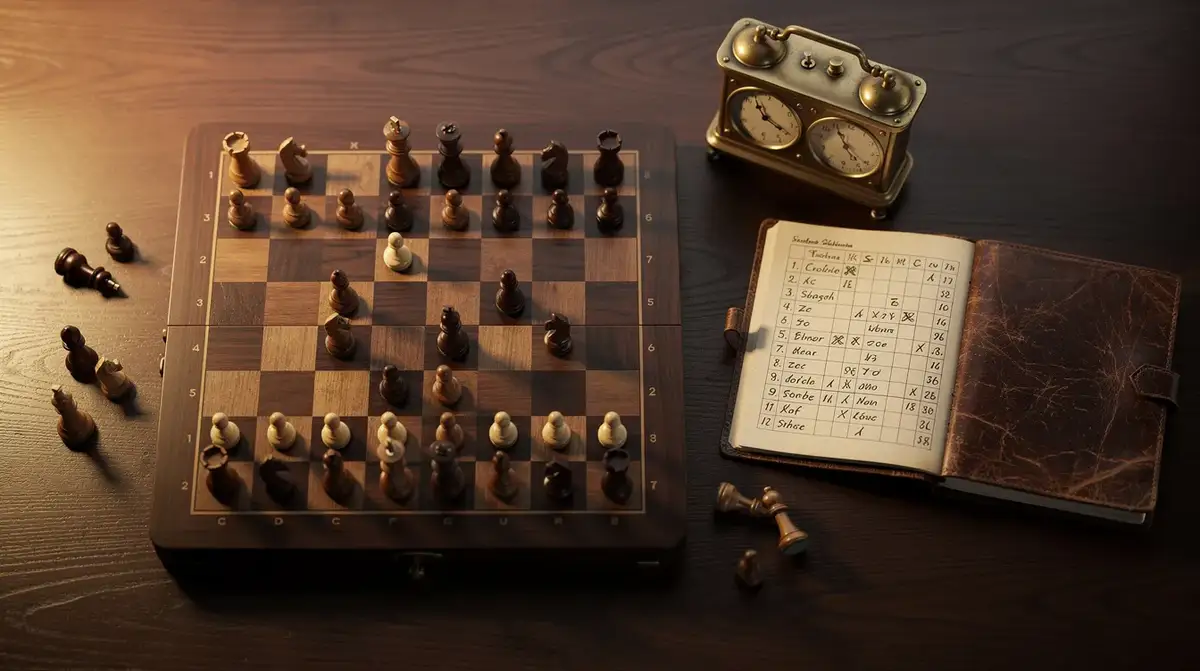
A game analyzer helps you find mistakes by evaluating every position in your game and classifying each move as excellent, good, inaccuracy, mistake, or blunder based on how much it changes the objective evaluation. The key is not just reading the output - it is understanding why a move was a mistake and what the correct idea was.
Here is a practical workflow for getting maximum value from game analysis tools:
Step 1 - Import Your Game in PGN Format
PGN (Portable Game Notation) is the standard format for recording chess games. Most platforms let you export your games as a PGN file with a single click. Our game analyzer accepts PGN input directly and generates a full move-by-move breakdown including centipawn loss per move, missed tactics detection, and overall accuracy scores.
Step 2 - Focus on Blunders and Mistakes First
A blunder is typically defined as a move that loses more than 2 pawns of value (200 centipawns or more). A mistake costs 1-2 pawns. Inaccuracies are smaller errors. Start with your blunders. There will often only be 1-3 of them in a game, and they are the moves that had the biggest impact on the result. Understand the exact tactic or positional idea you missed in each case.
Step 3 - Look at Your Inaccuracies Thematically
Once you have studied your biggest errors, look at the smaller inaccuracies and see if there is a theme. Are you consistently placing your bishop on passive squares? Are you trading pieces when you have the initiative? Are you missing opportunities to double rooks on open files? Patterns in your inaccuracies reveal deeper strategic misunderstandings.
Step 4 - Study the Suggested Best Moves
Do not just see what the best move was - understand the idea behind it. If the engine suggests 1. Nf3 followed by a knight maneuver to d5, ask yourself: what does the knight do on d5? Why is that square powerful? Why was my move worse? Connecting engine suggestions to chess principles is what makes analysis stick in your memory.
Common trap: Many players look at engine analysis, see a long string of best moves they do not understand, and simply accept that they "played badly" without extracting any lesson. If you cannot explain in one sentence why the engine's suggestion is better than your move, keep studying that position until you can.
What Are the Most Common Mistakes to Watch for in Your Own Games?
The most common chess mistakes that appear across games from 800 to 1800 rating are leaving pieces undefended, missing opponent tactical threats (especially forks and pins), poor piece coordination, and losing the initiative by making passive or reactive moves. Recognizing your personal frequency of each error type is the foundation of targeted improvement.
Here is a breakdown of the most impactful mistake categories to track in your self-analysis:
- Hanging pieces (undefended pieces): The number one cause of rating loss at all levels below 1800. After each of your moves, develop the habit of asking: "Am I leaving any piece unprotected?"
- Missing forks: A fork attacks two pieces simultaneously with one move. Knights on outpost squares are the most common source of forks. Scan for knight fork patterns - especially Nf7 or Nd5 threats - every few moves.
- Ignoring back-rank weakness: Many games at the 1000-1400 level are decided by a back-rank checkmate (Rd8# or Qd8# patterns). Always check if your king has an escape square on the back rank.
- Premature attacks: Launching an attack before your pieces are developed and coordinated. A common example is playing 1.e4 e5 2.Nf3 Nc6 3.Bc4 and immediately trying for a Scholar's Mate (4.Qh5) without completing development. Premature attacks almost always backfire against solid play.
- Passive piece placement: Bishops blocked by your own pawns, knights on the rim (h1, h8, a1, a8), rooks with no open or half-open files to work on. These are silent rating killers because the damage is slow and hard to see.
- Time pressure errors: A disproportionate number of mistakes happen in the last 2 minutes of a game. If you notice many errors in your endgames, consider whether time management earlier in the game is the real problem.
When you analyze a batch of 10-20 games, create a simple tally of which mistake types appear most often. That list is your personal improvement priority list. The category with the most ticks gets studied first through targeted tactics practice.
Tracking your personal mistake frequency across multiple games is far more powerful than analyzing one game deeply. Look for patterns, not just isolated blunders. Your most frequent mistake type is worth 50-100 rating points when fixed.
Should You Analyze Your Openings as Part of Game Review?
Yes, you should analyze your openings as part of every game review, but with a specific focus: identify whether you left your preparation and why, not just memorize more moves. Opening problems usually reveal themselves in the first 10-15 moves, but their consequences (a bad pawn structure, a passive bishop, a weakened king) often decide the game 20 moves later.
When reviewing opening play in your games, focus on these questions:
- At what exact move did you leave a known opening line? Was it move 5, move 8, or move 12?
- When you made that first unfamiliar move, what were you trying to achieve? Was your idea sound but poorly executed, or was the idea itself flawed?
- Did you end up with good or bad piece placement coming out of the opening? Specifically, were your bishops active or blocked, and were your rooks connected?
- Did your opponent do something unexpected that you had not seen before? If so, that specific line deserves dedicated study.
Using an openings explorer alongside your game review can be incredibly powerful here. You can see the most common responses to your opponent's moves, understand the win/draw/loss statistics for each variation, and learn the main plans for both sides in the positions you regularly face.
Pro tip: Do not try to memorize 15 moves of theory after every game loss. Instead, find the single move where you went wrong and learn just the correct response to it, plus the main idea behind it. Add 2-3 moves of understanding at a time. Small, consistent opening study compounds quickly over weeks.
How Can You Identify Tactical Patterns You Keep Missing?
You can identify tactical patterns you keep missing by cross-referencing your game analysis with a structured tactics trainer - look for the specific tactic types (fork, pin, skewer, discovered attack, deflection) that appeared as missed opportunities in your games and then drill those exact pattern types until they become automatic.
This is where game analysis and targeted training connect directly. Here is the process:
Building Your Personal Tactics Weakness List
After analyzing 5-10 games, you will likely notice that you are missing the same types of tactics repeatedly. Perhaps you consistently miss knight forks on outpost squares, or you overlook discovered attacks when bishops are aligned on diagonals. Write these down explicitly - "I keep missing forks involving knights on d5/d4" or "I overlook pins along the e-file."
Targeted Puzzle Drilling
Once you have your weakness list, do not solve random puzzles - solve puzzles filtered to your exact problem areas. Our chess puzzles and tactics trainer covers all major tactical motifs including forks, pins, skewers, back-rank mates, sacrifices, deflections, discovered attacks, and trapped pieces. Focusing your puzzle sessions on your personal weak spots makes your training time 3-4 times more efficient than random puzzle solving.
The Visualization Check
One of the most useful exercises after finding a missed tactic in your game is this: set up the position on a board (physical or digital), look at it for 30 seconds, then close your eyes and try to visualize the winning sequence. Can you see all the moves in your mind? If not, practice until you can. This builds the pattern recognition that makes you see these tactics in future games at the board.
Tactics are not calculated from scratch every time. They are recognized. The goal of puzzle training is not to learn how to calculate - it is to build a library of visual patterns that your brain recognizes instantly under time pressure.
When Is the Best Time to Analyze an Endgame You Lost or Drew?
The best time to analyze an endgame is immediately after the game while the position is still fresh in your memory, but the most valuable analysis comes when you study it alongside a reference of classical endgame principles - comparing your decisions to the correct technique rather than just looking at engine moves.
Endgames are where many intermediate players bleed the most unnecessary rating points. You can play a perfect middlegame, convert a winning position, and then mishandle the endgame and end up drawing or even losing. Here are the most important endgame questions to ask during analysis:
- Did you activate your king early enough? In most endgames (especially king-and-pawn endings), the king must be centralized actively. Many players keep their king passively on the back rank out of instinct.
- Did you create a passed pawn when you had the chance? A passed pawn in an endgame is an enormous advantage. Look for moments when a pawn break or exchange would have created one.
- Did you understand which pieces to keep? In rook endgames, the rook belongs behind passed pawns. In opposite-color bishop endings, understand whether you were playing for a win or a draw and whether your strategy matched the position's requirements.
- Did you miss a zugzwang pattern? Zugzwang (where being forced to move makes your position worse) is fundamental to king-and-pawn endgames. Recognizing when your opponent is in zugzwang - or when you will be - decides many technical endgames.
If your analysis reveals endgame technique as a consistent weakness, structured endgame training with progressive difficulty tiers is the most efficient way to close that gap.
Common trap: Skipping endgame analysis because "I already know I misplayed it" is one of the most costly habits in chess improvement. Vague awareness that you "played badly" in the endgame is not learning. You need to identify the exact principle you violated at the exact move to avoid repeating it.
Can Playing Against AI Bots Help Reinforce What You Learn from Game Analysis?
Yes, playing against AI bots with specific playing styles is one of the most effective ways to reinforce lessons from game analysis, because you can practice the exact types of positions and strategic challenges that your analysis revealed as weaknesses - on demand and without waiting for the right opponent to appear.
Here is how to combine self-analysis with bot training effectively:
Match the Bot Personality to Your Weakness
If your game analysis shows you struggle against aggressive attacking play, deliberately play against an attacking-style bot to practice defensive technique. If you lose endgames consistently, practice against an endgame-specialist bot that creates technical endings. Our human-like chess bots are trained on real human games and each has a distinct playing personality - making them ideal for targeted practice rather than just random play.
Use Bot Learning Mode for Position-Specific Training
If your game analysis reveals a recurring strategic misunderstanding (say, you consistently misplace your knights in closed positions), you can use an interactive learning mode to explore those position types with AI guidance. The learn chess with AI mode provides move visualization and interactive feedback that bridges the gap between analysis and practical improvement.
Game analysis tells you what to fix. Targeted practice - through puzzles, bot games, and structured training - is how you fix it. The analysis-practice loop is the engine of chess improvement: analyze to find weaknesses, train to fix them, play to test the improvement, then analyze again.
How Often Should You Analyze Your Games to See Consistent Rating Improvement?
To see consistent rating improvement, analyze at least one game per week in depth, and do a quick self-review (without engine) of every game you play. The quality and consistency of analysis matters more than the quantity - one thorough 30-minute analysis session is worth more than briefly skimming ten games.
Here is a realistic weekly schedule that combines game analysis with targeted improvement training:
- After every game (5 minutes): Replay the game mentally. Identify the one move you are most uncertain about. Write it down in a notebook or digital log.
- Once per week (30 minutes): Choose one game (ideally a loss or a drawn game you should have won) and do a full analysis. Use engine assistance but focus on understanding, not just listing mistakes.
- Weekly puzzle session (20-30 minutes): Drill the tactic type that appeared most in your recent game mistakes.
- Monthly review (15 minutes): Look back at your mistake log. Are the same errors still appearing? Have some errors disappeared? Adjust your training priorities accordingly.
This rhythm is sustainable even for adult players with limited time. The key is consistency over intensity. Regular short analysis sessions compound over months into dramatic improvement, while occasional marathon study sessions tend to produce temporary boosts that fade quickly.
Pro tip: Keep a simple "mistake journal" - a document or notebook where you log your recurring errors with a position diagram and the correct idea. Review it before each study session. Players who maintain this habit typically improve 150-200 rating points faster than those who do not, because they stop repeating the same expensive mistakes.
What Is the Complete Step-by-Step Process for Analyzing a Chess Game?
The complete process for analyzing a chess game involves six steps: initial self-review without engine assistance, identifying the turning point, engine-assisted mistake classification, opening phase review, tactical pattern extraction, and a final summary of lessons learned. Following all six steps ensures you extract maximum learning value from every game.
Here is the complete framework condensed into a clear checklist:
- Self-review first (5 minutes): Replay the game and write down your assessment of where it went wrong before seeing any engine evaluation.
- Identify the critical moment (2 minutes): Find the single move that most changed the game's trajectory. This is your primary lesson focus.
- Engine analysis (10 minutes): Run the game through a game analyzer. Note all blunders and mistakes. Compare the engine verdict to your own assessment.
- Opening review (5 minutes): Where did your preparation end? Was your piece placement after the opening phase active or passive? Note any new opponent ideas for future study.
- Tactic extraction (5 minutes): For each missed tactic in the game, name the tactic type (fork, pin, skewer, etc.) and add it to your tactics weakness list.
- Write a lesson summary (3 minutes): In 2-4 sentences, summarize the main lesson from this game. "I need to check for knight forks before trading on d5" or "I played too passively after gaining a pawn advantage - I need to activate my rooks." This written summary is the actual learning that drives improvement.
The most important output from any game analysis is not a list of mistakes. It is a single clear lesson that you can carry into your next game and consciously apply. One lesson learned and applied is worth a hundred blunders identified and forgotten.
The tools you need to turn your games into lessons are right here. Use our game analyzer to find your exact mistakes, our chess puzzles and tactics trainer to drill the patterns you keep missing, and our human-like chess bots to practice the specific positions and styles that challenge you most. Your next 100 rating points are hidden in the games you have already played - it is time to find them.