

Hanging pawns are one of the most misunderstood structures in chess. They look weak, they can be attacked from multiple angles, and many players simply avoid them altogether. But in the hands of a player who understands their power, hanging pawns become a dynamic weapon that generates space, controls key squares, and supports a devastating attack. This guide will teach you exactly how to use hanging pawns to win more games.
What Are Hanging Pawns in Chess?
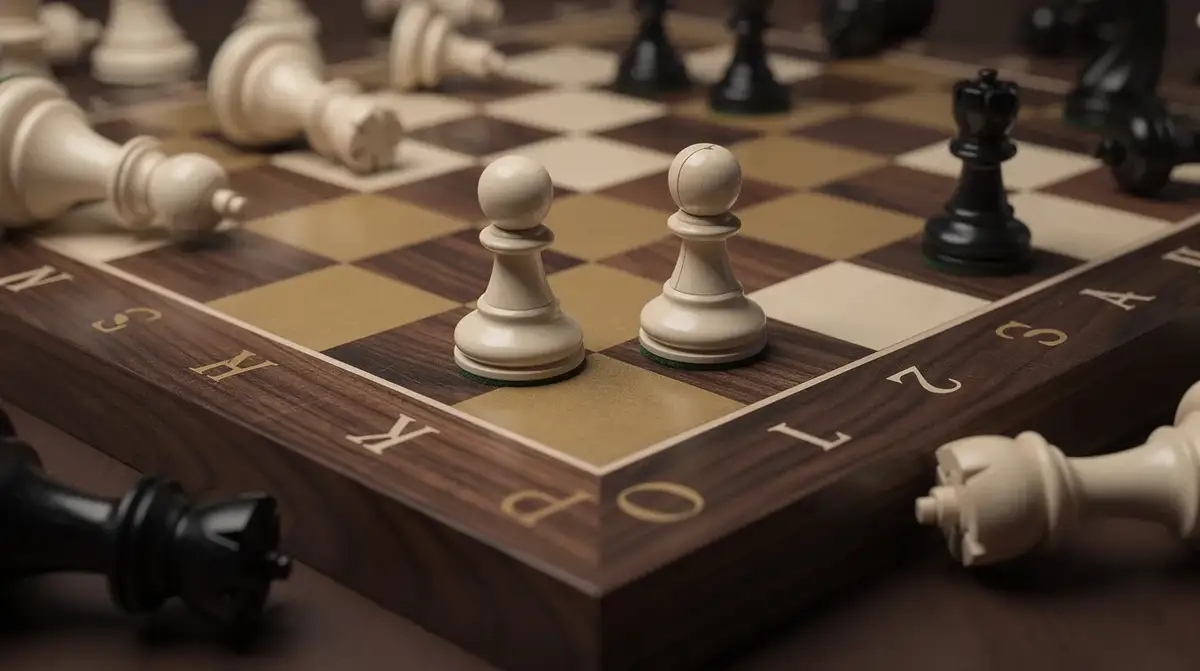
Hanging pawns are a pair of connected, side-by-side pawns on the fourth or fifth rank that have no friendly pawns on either adjacent file to support them. The most common example is a white pawn on c5 paired with a white pawn on d5, or equivalently Black having pawns on c5 and d5 against a White setup with pieces on the flanks. They are called "hanging" because they cannot be defended by other pawns - they are vulnerable from the side files and must be defended entirely by pieces.
The term was popularized by Soviet chess literature, and the structure most frequently arises from Queen's Gambit-related openings such as the Nimzo-Indian Defense, the Queen's Gambit Declined, and certain lines of the Semi-Tarrasch. Understanding this structure is essential for any player looking to improve from the 1000-1800 range.
For a broader understanding of how pawn formations influence your entire game plan, the Pawn Structure: How to Plan Your Chess Strategy guide offers an excellent foundation before diving deeper into hanging pawns specifically.
Hanging pawns on c5 and d5 control important central squares (c4, d4, e5, e6) and give the side holding them a space advantage - but they require active piece play to justify their existence. Passivity is fatal with hanging pawns.
Why Are Hanging Pawns Both Powerful and Dangerous?
Hanging pawns are simultaneously a strength and a weakness - their value depends entirely on the position and whose pieces are more active. On the positive side, they control a wide swathe of central squares, they can advance to create passed pawns or open lines, and they support piece outposts. On the negative side, they can become targets once the position simplifies or when pieces are traded off, leaving them indefensible by material that has been exchanged.
The Strengths of Hanging Pawns
- Space advantage: Pawns on c5-d5 or c4-d4 control squares on both sides of the board, making it harder for your opponent to find good squares for their pieces.
- Piece activity: Your rooks, bishops, and queen naturally find open lines behind and beside the hanging pawns, especially on the c-file and d-file.
- Advance threat: The threat of pushing d5-d6 or c5-c6 is often more powerful than the advance itself, keeping the opponent permanently on the defensive.
- Attack on the kingside: When the opponent castles kingside, a well-timed pawn advance (especially d5-d6 or even a supported e5-e6) can crack open the king's shelter.
The Weaknesses to Be Aware Of
- Blockade: If the opponent places a piece - especially a knight - in front of one of the hanging pawns (on c4, d4, or e5 for example), the pawns lose most of their dynamism.
- Endgame fragility: In simplified positions, hanging pawns often become chronic weaknesses because pieces are no longer available to defend them.
- Over-extension: Advancing both pawns without coordination can leave one pawn isolated and easily won.
Common trap: Many intermediate players advance their hanging pawns too early, before their pieces are coordinated to support the advance. This turns a dynamic asset into a static weakness. Always activate your rooks and bishop(s) before launching the pawns forward.
How Do Hanging Pawns Arise in Common Openings?
Hanging pawns most commonly arise from the Queen's Gambit family of openings, particularly when one side accepts an isolated queen pawn (IQP) and then unblocks it by exchanging a flank pawn to create the pair. The most typical route is through the Semi-Tarrasch Defense or certain Nimzo-Indian lines.
The Semi-Tarrasch Route (A Classic Example)
Consider this sequence from the Semi-Tarrasch Defense:
- 1.d4 d5 2.c4 e6 3.Nf3 Nf6 4.Nc3 c5
- After 5.cxd5 Nxd5 6.e4 Nxc3 7.bxc3 cxd4 8.cxd4 - White has hanging pawns on c3 and d4 (or in a mirror, Black can generate c5-d5 hanging pawns in similar lines)
The resulting position gives White a classical hanging pawn complex. The pawns control e5 and e4 respectively, and White's pieces naturally flow to active squares. The key is to never let the opponent install a strong blockading piece.
The Nimzo-Indian Connection
In the Nimzo-Indian Defense (1.d4 Nf6 2.c4 e6 3.Nc3 Bb4), many lines result in White having doubled pawns on c3 and c4, which can transform into a hanging pawn structure after strategic pawn trades. Black, for example, can generate hanging pawns on c5 and d5 through lines where the game reaches a symmetrical structure and one side pushes a central pawn.
To explore these openings more deeply and see move probabilities and typical continuations, the openings explorer on this platform is an excellent resource for studying the exact move orders that lead to these structures.
Pro tip: When playing openings that lead to hanging pawns, study the resulting middlegame plans BEFORE memorizing the opening moves. Knowing what you are aiming for makes the opening moves feel logical rather than memorized.
If you want a more structured way to build your understanding of these opening systems and the resulting middlegames, consider reading How to Build a Chess Opening Repertoire From Scratch for a step-by-step approach.
What Are the Three Main Strategic Plans With Hanging Pawns?
There are exactly three strategic plans available to the side holding hanging pawns, and recognizing which plan to execute - and when - is the entire art of playing this structure correctly. The three plans are: advance one pawn, trade the pawns favorably, or use the pawns as a positional anchor while attacking on the flanks.
Plan 1 - The Pawn Advance (Attack)
This is the most exciting plan and the one that wins the most brilliant games. When your pieces are fully coordinated and your opponent's position is slightly passive, you push one of the hanging pawns forward aggressively.
The classic example: with White having pawns on c5 and d5 and Black having castled kingside, the move d5-d6 can be devastating. It either forces a concession (Black plays ...e6 to stop Bf4-d6 threats, weakening the kingside) or opens the d-file for a rook invasion. Even stronger, if White can support the advance with e4-e5 before pushing d5-d6, the coordinated pawn roller can simply overwhelm Black's defenses.
The key conditions for the advance plan:
- Your rooks are on the c-file and d-file (or ready to occupy them)
- Your bishops are active and pointing toward the enemy king
- The opponent has no immediate counterplay on the queenside
- You have a space advantage overall
Plan 2 - The Favorable Trade
Sometimes the best plan is to exchange the hanging pawns in a way that creates a passed pawn or opens a file for your rooks. For example, if White has pawns on c5-d5 and Black plays ...e6xd5, White recaptures cxd5, now having a passed d-pawn - one of the most powerful assets in the middlegame and endgame.
The favorable trade plan works when:
- The opponent is about to attack the hanging pawns with pieces anyway
- Allowing one pawn trade creates a powerful passed pawn
- Your rooks can immediately occupy the newly opened file after the trade
For more on converting passed pawn advantages, the article on Passed Pawn Strategy: How to Win Chess Endgames directly applies to positions that arise after favorable trades from a hanging pawn structure.
Plan 3 - The Positional Anchor (Piece Play)
The third plan is the most subtle. You keep the hanging pawns static and use the space they control to place your pieces on dominant squares. The pawns on c5 and d5 prevent the opponent from placing knights or bishops on c4, d4, e4, or e5. Your own pieces occupy these central outposts instead.
A bishop on d3 (pointing at the kingside), a knight on e4 (outpost protected by d5), and a queen on c2 or d3 coordinating for a kingside attack is a classic winning setup when the hanging pawns serve as the anchor.
The right plan depends on your opponent's moves. If they passively defend, advance. If they attack the pawns with pieces, trade favorably. If they wait, use the pawns as an anchor for dominant piece play. Flexibility is everything with hanging pawns.
How Should You React When the Opponent Attacks Your Hanging Pawns?
When the opponent directly attacks one of your hanging pawns, you must respond with active counterplay rather than passive defense. Simply doubling rooks on the d-file to defend a pawn on d5 is usually insufficient - the opponent will pile up more attackers and eventually win the pawn or force a passive position.
Counter-Attack Rather Than Simply Defend
The correct response to an attack on the hanging pawns is almost always a counter-threat or an advance. For example, if Black plays ...Nd4 attacking the c2 square (putting pressure on a pawn behind c5), White should not retreat passively - instead, White should look for Nxd4 to remove the attacking piece, or e5 to chase the knight and gain more space.
Identifying the Blockade Threat
The single most dangerous plan against hanging pawns is the blockade. If your opponent can place a knight on d4 (blockading the d5 pawn) or on c4 (blockading the c5 pawn), your hanging pawns are frozen and will become long-term targets. Always monitor for this and either prevent it or immediately exchange the blockading piece.
The famous rule of hanging pawns: never allow a well-placed knight to blockade both pawns simultaneously. If the opponent threatens Nd4 and you cannot prevent it with a piece move, consider whether a pawn advance (d5-d6 or c5-c6) is immediately available to disrupt the blockade before it is established.
Pro tip: Use the game analyzer to review your own games where you held hanging pawns. Look specifically for the move where you switched from dynamic play to passive defense - this is usually where the position started to deteriorate.
The Exchange Sacrifice to Preserve Dynamism
Advanced players will sometimes sacrifice the exchange (rook for bishop or knight) to either remove a blockading piece or to maintain the dynamism of their hanging pawns. If a knight on d4 is dominating your position, Rxd4 cxd4 followed by activating your bishops on open diagonals can be fully justified positionally. This type of decision requires the ability to evaluate compensation accurately - the How to Sacrifice Pieces in Chess and Win More Games article covers the decision-making framework in detail.
How Do You Play Against an Opponent Who Has Hanging Pawns?
The strategic blueprint against an opponent holding hanging pawns is straightforward: provoke them into advancing prematurely, exchange pieces to enter a favorable endgame, and establish a permanent blockade. Do not give your opponent free moves to improve their piece placement without creating threats of your own.
Step 1 - Exchange Active Pieces
Hanging pawns need piece activity to be dangerous. Every time you successfully exchange a well-placed piece from your opponent - particularly their bishops on aggressive diagonals or their most active rook - you reduce the hanging pawns from a dynamic weapon to a static weakness.
Step 2 - Provoke the Advance
Place your pieces to create the illusion that an advance is necessary. If your opponent feels forced to push d5-d6 before their pieces are coordinated, the advance can backfire. A premature d5-d6 with uncoordinated pieces simply opens the d-file for your rooks and creates a pawn that is easily blockaded on d6.
Step 3 - Establish a Blockade
A knight on d4 blockading the d5 pawn is worth more than a bishop in many of these positions. Once you have a blockade piece in place, systematically exchange all the opponent's other active pieces. The blocked hanging pawns will gradually transition into the endgame as chronic weaknesses that will eventually cost material.
Step 4 - Convert in the Endgame
In the endgame, hanging pawns without piece support are typically losing. Target them with your rooks on open files and use your king actively. If you reach a rook endgame with the hanging pawns still on the board, the side defending them faces an almost impossible task of protecting two separate pawn weaknesses simultaneously.
For more on converting endgame advantages against weak pawn structures, the guide on How to Win Chess Endgames: Essential Techniques covers the specific techniques needed.
Common trap: Do not rush to win the hanging pawns immediately. Many players grab one pawn with a rook only to find the remaining pawn advances and becomes a powerful passed pawn. Blockade first, exchange pieces, THEN harvest the pawns in a simplified position where your opponent has no compensation.
What Are the Most Important Middlegame Techniques for Hanging Pawn Positions?
Mastering hanging pawn positions requires a set of specific middlegame techniques that go beyond general chess principles. The most important are: piece coordination around the pawn chain, prophylaxis against blockade, and timing the transition to a favorable endgame or attack.
Rook Placement on Semi-Open Files
Your rooks belong on the c-file and d-file in almost every hanging pawn position. From c1 (or c8 for Black), a rook supports the c5 pawn and threatens c5-c6 at the right moment. From d1, the rook supports the d5 pawn and prepares a d-file invasion after any exchange. Never leave your rooks on the a-file or b-file without a concrete plan - they are wasted there when your central pawns demand active support.
The Bishop Pair With Hanging Pawns
The bishop pair is particularly powerful in combination with hanging pawns. A bishop on d3 hitting towards h7 paired with one on b2 pointing along the a1-h8 diagonal creates a deadly long-term attacking setup. The hanging pawns control the central squares that knights typically use to interfere with these diagonals, meaning the bishops have almost unimpeded activity.
For more on maximizing your bishop pair, the article How to Play Chess With Two Bishops and Win is directly relevant to hanging pawn middlegames where you retain both bishops.
Queen Placement and Coordination
The queen typically works best on c2 or d3 (for White) in hanging pawn positions. From c2, the queen eyes h7 in combination with a bishop on d3, and supports the c5 pawn from behind. From d3, the queen creates immediate threats toward the kingside and also reinforces the d5 pawn. Avoid placing the queen on passive squares like d1 or e2 where it contributes nothing to the position's central energy.
With hanging pawns, piece coordination is everything. Rooks on the c-file and d-file, bishops pointing toward the enemy king, and queen on an aggressive central square is the ideal setup. Once your pieces reach this configuration, the hanging pawns become genuinely dangerous.
Practicing These Middlegame Patterns
The tactical patterns that arise from hanging pawn positions - forks on blockading knights, discovered attacks after a pawn advance, deflections of defending pieces - all recur across hundreds of games. Training these patterns is one of the fastest ways to improve your practical handling of this structure. The chess puzzles and tactics trainer on this platform includes puzzles specifically designed around these kinds of central pawn tension scenarios.
You can also test your understanding in real games against the human-like chess bots on this platform, which are trained on real human games and will challenge your hanging pawn play with the same kind of blockade and counter-attack strategies a human opponent would use.
What Are the Most Instructive Grandmaster Games Featuring Hanging Pawns?
The hanging pawn structure has been used by some of the greatest chess players in history, with specific games serving as textbook examples of both the correct handling and the pitfalls to avoid. Two games stand out as must-study for any player wanting to understand this structure at a deep level.
Karpov's Blockade Technique
Anatoly Karpov was the greatest master of playing against hanging pawns in chess history. His games consistently demonstrated the blockade-and-simplify approach: exchange the opponent's active pieces, place a knight or bishop on the blockading square in front of the central pawn, trade into a favorable endgame, and convert the resulting weakness with his incredibly precise endgame technique. Studying any Karpov game where he plays against a Nimzo-Indian or Queen's Gambit structure with hanging pawns will teach you more about the defensive side than any textbook.
Kasparov's Dynamic Approach
Garry Kasparov, in contrast, was the supreme master of using hanging pawns as a launching pad for kingside attacks. His games from the 1980s and 1990s frequently featured the advance plan - sacrificing a pawn or even exchanging it to rip open lines against the enemy king. His game against Karpov in the 1985 World Championship match is particularly instructive, where hanging pawns were used to generate relentless pressure that eventually cracked Karpov's defensive setup.
"The hanging pawns are the soul of an attack - they do not ask for safety, they demand activity. Defend them with pieces, and you have lost their essence." - Adapted from Soviet chess theory on dynamic pawn structures.
Improving Your Own Pattern Recognition
The more positions you see with hanging pawns, the faster you will recognize the correct plan in your own games. Using the game analyzer to review your games with this structure - looking specifically at which plan you chose and whether it was correct - accelerates improvement dramatically. Combine this with the How to Improve Your Chess Rating by Analyzing Games approach for a complete improvement system.
Frequently Asked Questions About Hanging Pawns
Are hanging pawns stronger in the middlegame or endgame?
Hanging pawns are almost always stronger in the middlegame. The activity of your pieces is what makes them dangerous, and in the middlegame you have the most pieces available to coordinate around them. In the endgame, with fewer pieces, the hanging pawns tend to become targets that require constant defensive attention. If you are holding hanging pawns and the position is heading toward an endgame, consider whether you can convert them into a passed pawn by trading one of the pair before too many pieces come off the board.
What is the difference between hanging pawns and an isolated queen pawn (IQP)?
An isolated queen pawn (IQP) is a single pawn on the d-file with no friendly pawns on the adjacent c-file or e-file. Hanging pawns are a pair of pawns (typically c5-d5 or c4-d4) that have no pawns supporting them from the flanks. The IQP is a single weakness but provides less space and fewer attacking threats. Hanging pawns provide more space and more attacking potential, but create two potential weaknesses instead of one. The strategic principles overlap - both require active piece play, both are dangerous in the middlegame and weak in the endgame. For more on the IQP specifically, see Isolated Pawns in Chess: Turn the IQP Into a Weapon.
Should beginners avoid hanging pawn structures?
Not necessarily. Beginners should understand the basic principles (activity is essential, blockade is the main threat, advance when pieces are coordinated) before regularly playing these structures. The beginner chess school covers fundamental pawn structure concepts that make understanding hanging pawns much more accessible. Once you have the basics, playing positions with hanging pawns is actually excellent training because the plans are concrete and the feedback on whether you played correctly is immediate.
Can hanging pawns appear in endgames?
Yes, hanging pawns can survive into endgames, but their character changes fundamentally. In the endgame, they are typically targets rather than weapons unless one of them can quickly become a passed pawn. If you find yourself in a rook endgame with hanging pawns still on the board, your priority should be to activate your king to defend them or to create a passed pawn from the pair before your opponent's rook becomes too active. The endgame training section on this platform includes positions with isolated and connected pawn scenarios that help develop the exact technique needed.
How do I train my intuition for hanging pawn positions?
The fastest method is to play many games from hanging pawn positions, analyze them carefully, and study grandmaster games featuring this structure. You can set up specific hanging pawn positions and practice against the AI on this platform to develop your sense of when to advance, when to trade, and when to simply improve your pieces. The learn chess with AI feature is particularly useful because it shows you why certain moves are stronger in the context of the position, building your intuition much faster than pure memorization.
Hanging pawns reward active, dynamic play and punish passivity. Master the three plans (advance, trade favorably, use as anchor), always prioritize piece coordination over pawn defense, prevent the blockade at all costs, and practice these positions regularly against strong opponents. The players who win with hanging pawns are those who treat the pawns as a launching pad for their pieces - not as objects to be defended at all costs. Start practicing today, analyze your games, and your handling of this structure will improve rapidly.
Ready to put this knowledge into practice? Test your hanging pawn middlegame skills in real games, solve tactical puzzles from hanging pawn positions, and analyze your games to see exactly where your plans succeed or fall apart. The fastest improvement comes from combining study with active practice - and every tool you need is available right here on PlayChessOnline.eu.
For further study of related positional topics that directly connect to hanging pawn strategy, explore How to Play Positional Chess When No Tactics Exist for the broader positional framework, and Chess Middlegame Planning: Never Feel Lost Again to improve your ability to find the right plan in complex central pawn structures like the ones hanging pawns create.