

Space advantage in chess is one of the most powerful - and most misunderstood - strategic concepts in the game. When you control more of the board than your opponent, you gain freedom of movement, better piece coordination, and the ability to launch attacks from multiple directions. In this guide, you will learn exactly what a space advantage means, how to create and maintain one, and most importantly, how to convert it into a winning result.
What Is a Space Advantage in Chess and Why Does It Matter?
A space advantage in chess means you control more squares than your opponent - particularly in the center and on the side of the board where you plan to attack. When your pawns are advanced further into enemy territory, your pieces have more room to maneuver, while the opponent's pieces are squeezed into a narrow zone with very few good squares available.
Think of it like a boxing ring. If one fighter keeps backing the other into a corner, the cornered fighter cannot throw clean punches. In chess, the player with more space can reposition pieces freely, switch plans mid-game, and coordinate attacks that the cramped defender simply cannot counter effectively.
Space is not just about pawn advances, though. It is also about:
- Which squares your pieces actively control
- How many good moves your pieces have compared to your opponent's
- The number of open files and diagonals available to your major pieces
- Whether your opponent's pieces are passive or actively placed
"Chess is not about the number of pieces you have, but the power each piece controls. Space multiplies that power." - A fundamental positional truth every intermediate player must internalize.
To build a feel for spatial concepts, studying how to play positional chess when no tactics exist is an excellent starting point alongside this guide.
How Do You Measure a Space Advantage in Chess?
You measure a space advantage by counting the number of squares controlled past the 4th rank (for White) or past the 5th rank (for Black). A simple rule: if you have more pawns on the 4th, 5th, and 6th ranks than your opponent, you almost certainly have more space.
The Pawn Count Method
Grandmaster-level players use what is sometimes called the "pawn center" analysis. Count how many of your pawns sit on:
- The 4th rank - basic space, active center
- The 5th rank - strong space, opponent is restricted
- The 6th rank - dangerous space, often close to promotion or a direct attack
The Piece Mobility Check
Count how many legal moves each of your pieces has, then do the same for your opponent. If your pieces collectively have significantly more options, you have a functional space advantage even if the pawn structure looks balanced. Cramped pieces are less effective - a bishop with only two squares to move to is worth far less than its nominal value.
Pro tip: After every 10 moves, quickly scan the board and ask: "Does my opponent have any piece that is genuinely active?" If the answer is no, you already have a space advantage - now your job is to convert it before they free themselves.
Key Indicators of a Space Advantage
- Your pawns sit on d5, e5, or both (for White) - classic central space
- Your opponent cannot easily play ...c5 or ...f5 without losing material
- Their bishops are blocked by their own pawns
- Their knights have no good outpost squares (see: Chess Knight Outposts: Dominate the Board)
- Their rooks are stuck behind their own pawn chain
Which Chess Openings Give You the Best Space Advantage?
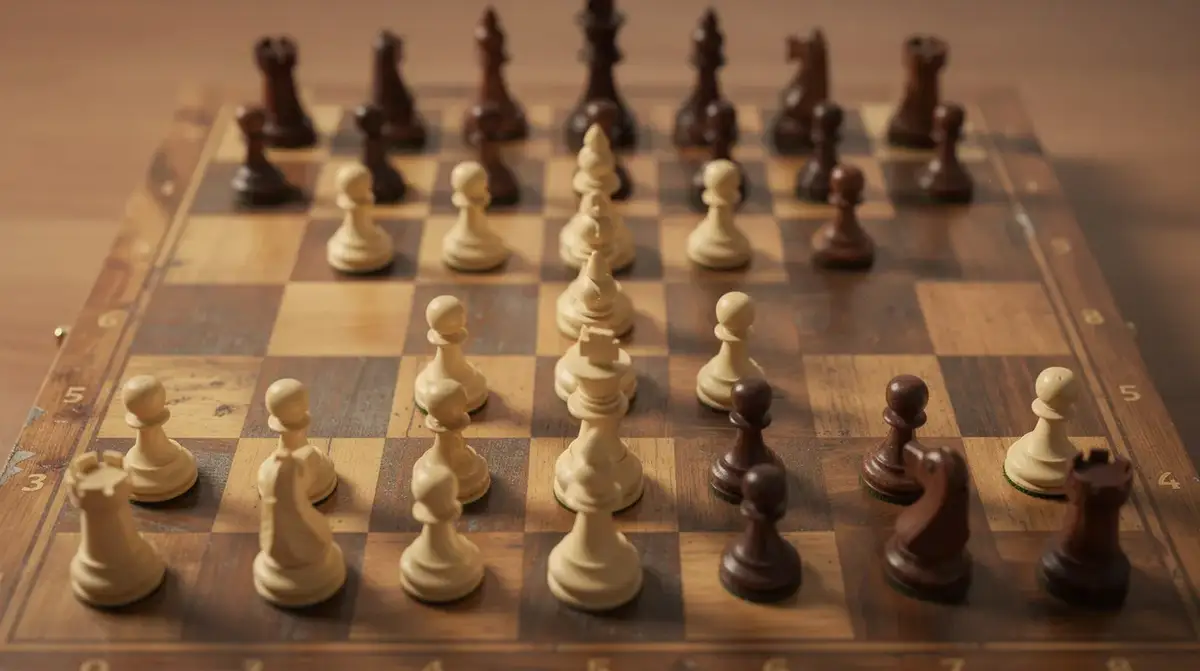
Several openings are specifically designed to grab space early and keep it. The most reliable space-grabbing openings for beginners and intermediate players are those that establish a strong central pawn presence in the first 5-7 moves.
King's Indian Attack (White)
After 1.e4 e5 2.Nf3 Nc6 3.d4, White immediately stakes a claim to the center. The Four Pawns Attack in the King's Indian Defense (1.d4 Nf6 2.c4 g6 3.Nc3 Bg7 4.e4 d6 5.f4) pushes four pawns to the 4th rank, creating maximum space at the cost of pawn structure solidity.
The English Opening - Space on the Queenside
1.c4 gives White a firm grip on d5 from the very first move. Following up with Nc3, g3, Bg2, and d3, White builds a massive queenside space advantage that is very difficult to challenge directly.
The Catalan Setup
1.d4 Nf6 2.c4 e6 3.g3 - the Catalan gives White a space edge with the c4 pawn and the long diagonal for the fianchettoed bishop, combining space with piece activity. This is one of the most popular openings at the elite level precisely because the space advantage is real and persistent.
For Black - Fighting for Space
If you play Black and want space, consider:
- The Sicilian Defense (1.e4 c5) - Black grabs queenside space immediately and fights for d4
- The King's Indian Defense (1.d4 Nf6 2.c4 g6 3.Nc3 Bg7 4.e4 d6) - Black temporarily cedes center space but counterattacks violently with ...e5 or ...c5
- The Dutch Defense (1.d4 f5) - Black grabs kingside space aggressively from move one
Use our openings explorer to study the exact move orders and typical pawn structures that arise from each of these systems before choosing your weapon.
The best openings for space advantage are not random - they follow a clear logic: stake central territory early, develop pieces behind your advanced pawns, and prevent the opponent from achieving freeing pawn breaks. Learn your chosen opening's typical pawn structures, not just the move order.
How Do You Convert a Space Advantage Into a Win?
Converting a space advantage requires a specific process: restrict the opponent further, activate all your pieces in the extra space you own, then find the right moment to open lines and create a decisive attack or endgame advantage. Simply having more space is not enough - you must actively use it.
Step 1 - Prevent the Freeing Pawn Break
Your opponent will always be looking for one specific pawn move that frees their position. In most games, this is either ...c5, ...d5, ...e5, or ...f5 for Black, depending on the structure. Your first conversion task is to prevent that break at all costs.
For example, if you have pawns on d5 and e4, Black's dream is to play ...c6 followed by ...c5, exchanging your advanced d5 pawn and freeing their pieces. Stop this by:
- Placing a knight on c4 where it supports d6 and stops ...c5
- Advancing a3-b4-b5 to close the queenside entirely
- Using your queen or a rook to control the c5 square indirectly
Step 2 - Trade Your Bad Pieces, Keep the Good Ones
When you have more space, your pieces are naturally more active. But pay attention: not all your pieces are equal. Trade off your passive pieces (especially bishops blocked by your own pawn chain) and keep the pieces that benefit most from open space - typically knights on outposts, active rooks on open files, and mobile queens.
Common trap: Many players with a space advantage rush to attack immediately, only to find they have not restricted the opponent enough. If your opponent gets their freeing pawn break, your space advantage can vanish in two moves, leaving you with overextended pawns and weaknesses instead.
Step 3 - Accumulate Pressure with Zugzwang Threats
A massive space advantage often creates positions where your opponent runs out of good moves. Every move they make worsens their position - a concept closely related to zugzwang. You do not necessarily need to find a forced win immediately. Simply improve your pieces one by one, move by move, until your opponent has no good responses left.
Learn more about creating these no-move situations in our guide to Chess Zugzwang: Force Winning Positions Every Time.
Step 4 - Open Lines When Ready
Once your pieces are perfectly placed and your opponent is fully restricted, open the position with a pawn advance or exchange. Your active pieces will flood in through the opened lines while the opponent's passive pieces watch helplessly.
The classic recipe is: f4-f5 breaks in the King's Indian, e5-e6 breaks in the Sicilian, or c4-c5 breaks in queenside space structures. Time these breaks when all your pieces are coordinated and your king is safe.
What Are the Best Piece Placements When You Have More Space?
The best pieces to use when you have a space advantage are knights on deep outposts (especially the 5th or 6th rank), rooks on the 7th rank, and bishops on long open diagonals. These pieces multiply the effect of your spatial control by making every square in your opponent's camp feel threatened.
Knights Love Space
A knight on d6 or e6 for White is often worth more than a rook. It cannot be chased by pawns, it attacks multiple enemy squares simultaneously, and it completely demoralizes the opponent's position. In the Sicilian, a White knight on d6 (after 1.e4 c5 ...2. Nf3 ...3. d4 cxd4 4. Nxd4) with supporting pawn structure is a classic dominant piece in a space advantage position.
Rooks on the 7th Rank
When you have a space advantage, aim to place a rook on the 7th rank (for White) where it attacks unmoved pawns and restricts the enemy king. Two rooks on the 7th - a "pig formation" - is almost always decisive in conversion scenarios.
Bishops Behind Your Pawn Chain
If you have a bishop that supports your advanced pawn chain from behind, it is a long-term positional weapon even if it never moves. The opponent must always account for it breaking through if pawns are ever exchanged.
Pro tip: Use the "piece improvement" method: on each move, ask which of your pieces is the least active. Then find its ideal square and move it there. Repeat this process 5-6 times and your position becomes overwhelming even without a specific attack.
This concept of maximizing every piece is central to how to master piece coordination in chess - an essential skill when converting positional advantages.
How Do You Defend Against a Opponent's Space Advantage?
When you are the cramped player, the most important rule is to find and execute your one freeing pawn break as quickly as possible. Defense against a space advantage is not passive waiting - it is active resistance through precisely timed counterplay.
Find Your Freeing Move Immediately
As soon as the pawn structure is set, identify your freeing break and work toward it every move. If you are Black in a King's Indian structure, your break is ...e5 or ...c5. In a French Defense structure, it is often ...c5 or ...f6. Do not play random development moves - every move should contribute to making that break possible.
Exchange the Right Pieces
The cramped player generally benefits from piece exchanges, especially of the opponent's most dangerous active pieces. Trade knights for bishops when the knights are on strong outposts. Trade off your most passive pieces even at a small cost to open lines for your remaining pieces.
Use the Wing You Are Not Cramped In
Very often, your opponent's space advantage is concentrated in one area of the board. If they control the center and kingside, create counterplay on the queenside and vice versa. A flank attack when the center is closed is a legitimate way to neutralize space disadvantage.
Being cramped is not losing - it is a challenge that requires precision. The player with less space must find their freeing move, trade off passive pieces, and create counterplay on the wing where they have more room. Many games are won by the cramped defender after the overextended attacker weakens their own position.
Can You Win in the Endgame with a Space Advantage?
Yes - a space advantage translates very effectively into endgame wins because cramped pieces become even more passive with fewer pieces on the board, and advanced passed pawns become much harder to stop. The endgame is actually where many space advantages are finally converted after long, patient middlegame maneuvering.
Space Advantage and Passed Pawns
A space advantage often generates a passed pawn or the conditions to create one. When you have more space, your king can support your passed pawn more safely, and your opponent's king is often stuck on the back rank defending against your active rooks. This is why many positional games that seem "equal" in the middlegame convert into technical endgame wins for the space-advantaged player.
For more on converting these endgame positions, study Passed Pawn Strategy: How to Win Chess Endgames alongside your space advantage training.
King Activity in Endgames
In endgames, the player who used their space advantage well earlier will have a more active king position. An active king in a pawn endgame is often the deciding factor - it can both support your passed pawns and attack your opponent's weaknesses simultaneously.
Using Our Endgame Training Tools
Converting a space advantage in the endgame is a specific technical skill. Practice it with purpose using our endgame training module, which includes classic positions from pawn endgames, rook endgames, and minor piece endgames - all relevant to space advantage conversion.
How Can You Practice Space Advantage Concepts With AI?
The best way to practice space advantage concepts is to play opponents who specifically challenge your spatial control - and to analyze what went wrong when you lose your space. AI-powered training tools make this faster and more targeted than traditional study methods.
Play Bots with Distinct Playing Styles
Our human-like chess bots are trained on real human games and each bot has a distinct personality. The Attacking Bot, for example, will constantly fight for space and initiative, making it an excellent sparring partner for learning how to handle - and create - space advantages in real game conditions.
Analyze Your Games for Space Mistakes
After each game, review where your space advantage was created, maintained, or lost. Our game analyzer classifies moves and highlights missed positional opportunities, including moments where you could have seized more space or prevented your opponent's freeing break but didn't.
Solve Space-Related Tactics
Many tactical patterns - discovered attacks, deflections, piece sacrifices - are only possible because of prior space advantages. Solving puzzles regularly with our chess puzzles and tactics trainer will help you recognize the moment when your spatial control creates a concrete tactical opportunity.
Pro tip: When using the game analyzer, specifically look for the move where your opponent's position went from "cramped but solid" to "completely lost." That move is usually the key tactical idea born from your space advantage - understanding it will make you much better at converting spatial edges in future games.
What Are the Most Common Mistakes When Playing With a Space Advantage?
The biggest mistakes when playing with a space advantage are trading the wrong pieces, rushing an attack before pieces are ready, and ignoring the opponent's counterplay. Space advantages are perishable - they must be converted correctly or they can evaporate and leave you with structural weaknesses instead.
Mistake 1 - Trading Your Active Pieces
Beginners often feel generous when ahead and exchange pieces without thinking. But trading your active knight on d6 for a passive bishop is a catastrophic mistake. Your space advantage lives through your active pieces. Protect them.
Mistake 2 - Playing on the Wrong Side
If you have space on the kingside, attack on the kingside. Many players with a kingside space advantage inexplicably start queenside operations. Your space advantage tells you where to play - listen to it.
Mistake 3 - Ignoring Pawn Structure After the Break
When you finally open the position with your pawn break (f5, e6, c5, etc.), the resulting pawn structure may leave you with isolated or doubled pawns. Think ahead about what structure remains after the break and whether your pieces dominate in that structure. Read more about this in our guide to pawn structure: how to plan your chess strategy.
Mistake 4 - Not Controlling the Clock
Space advantage positions often require many subtle moves before the decisive breakthrough comes. If you are playing with a clock, use your time wisely in these positions. Rushing out of impatience is one of the most common ways to throw away a space advantage.
Common trap: Never assume your space advantage automatically wins. Chess history is full of games where the cramped player defended brilliantly, waited for one mistake from the space-advantaged player, and counterattacked to win. Stay precise, don't relax, and keep looking for your opponent's defensive ideas even when you feel in control.
How Should You Train to Improve Your Space Advantage Chess Skills?
Improving at space advantage chess requires a combination of opening preparation, positional pattern recognition, and regular game analysis. A structured weekly training routine is the most efficient approach for players rated 800-1800.
Weekly Training Plan for Space Advantage
- Monday/Thursday - Study one classic game where a grandmaster won with a space advantage (Karpov's games are perfect for this - he was the greatest space advantage player of all time)
- Tuesday/Friday - Solve 15-20 positional puzzles, specifically those involving piece restriction and pawn breaks
- Wednesday/Saturday - Play 3-5 slow games (at least 10 minutes per side) practicing your chosen space-grabbing opening
- Sunday - Analyze your week's games, identifying one moment per game where space played a role in the outcome
Study Karpov's Positional Masterclasses
Anatoly Karpov is universally recognized as the greatest positional player of the modern era. His games are textbooks of space advantage conversion. Study games like Karpov vs. Unzicker (1974), Karpov vs. Spassky (1974), and Karpov vs. Topalov (1994) to see exactly how a grandmaster restricts, accumulates, and converts space.
Learn From AI Opponents
Use our learn chess with AI feature to get real-time feedback on your positional decisions. The Bot Learn mode shows you visualizations of piece activity and square control, making space concepts visible in a way static books cannot replicate.
Space advantage mastery is a long-term investment. Players who study it consistently see dramatic improvements in their ability to win "equal" positions - because those positions are rarely truly equal when you understand space. Start with clear pawn structures, learn the critical freeing breaks, and practice converting small advantages with precision.
Frequently Asked Questions About Chess Space Advantage
Is a space advantage more important than material advantage?
In many positions, yes. A piece that has no good squares is functionally worthless even if it is technically on the board. Many grandmasters sacrifice a pawn to seize a lasting space advantage precisely because the long-term strategic value outweighs the immediate material cost. That said, both must be weighed together - a space advantage combined with material equality is very strong, but a space advantage combined with a large material deficit is rarely enough to win.
How do I stop my opponent from getting a space advantage?
Challenge their central pawns immediately. If they play 1.e4 e5 2.d4, you must take on d4 or challenge the center - allowing 2...d6 3.Nc3 4.Nf3 5.Bc4 with a massive White center is positionally very dangerous for Black. The key principle: fight for the center with your pawns, not just your pieces.
Can beginners play for space advantage, or is it too advanced?
Absolutely beginners can and should play for space. Simple setups like 1.e4 e5 2.d4 or 1.d4 d5 2.c4 give beginners a space advantage immediately without requiring deep opening knowledge. Our beginner chess school covers these fundamentals and helps new players understand how to use their spatial control from the very first game.
What is "hypermodern" space strategy?
Hypermodern openings (Reti, Nimzo-Indian, King's Indian Defense) deliberately let the opponent build a large center, then attack it from the flanks. Instead of occupying the center with pawns, hypermodern players control it with pieces and flank pawns. This is an advanced concept where you temporarily concede space to provoke overextension in your opponent, then counter-attack. It is best studied after mastering classical central space strategies.
Does space advantage matter in the endgame?
Enormously. In the endgame, advanced pawns mean your king is more active, your rooks have more space to operate, and your opponent is more likely to have passive piece placement. A space advantage from the middlegame very frequently translates directly into a technical endgame win. See also our post on how to win chess endgames: essential techniques for the specific methods of converting these structural edges.
Understanding space advantage is what separates positional players from beginners who rely only on tactics. Use our platform to play, analyze, and improve: challenge our human-like chess bots in space-dominated positions, review your games with the game analyzer, and sharpen your pattern recognition with the chess puzzles and tactics trainer. Every great positional player started by learning exactly what you have read today - now go put it into practice.