


Pawn chains are one of the most powerful and misunderstood structures in chess. When you lock pawns diagonally, you create a fortress with its own attack and defense logic - but most players never learn how to use them properly. In this guide, you will learn what a pawn chain actually is, how to attack and defend with it, which openings create them, and the concrete plans that turn a solid chain into a winning weapon.
What Is a Pawn Chain in Chess?
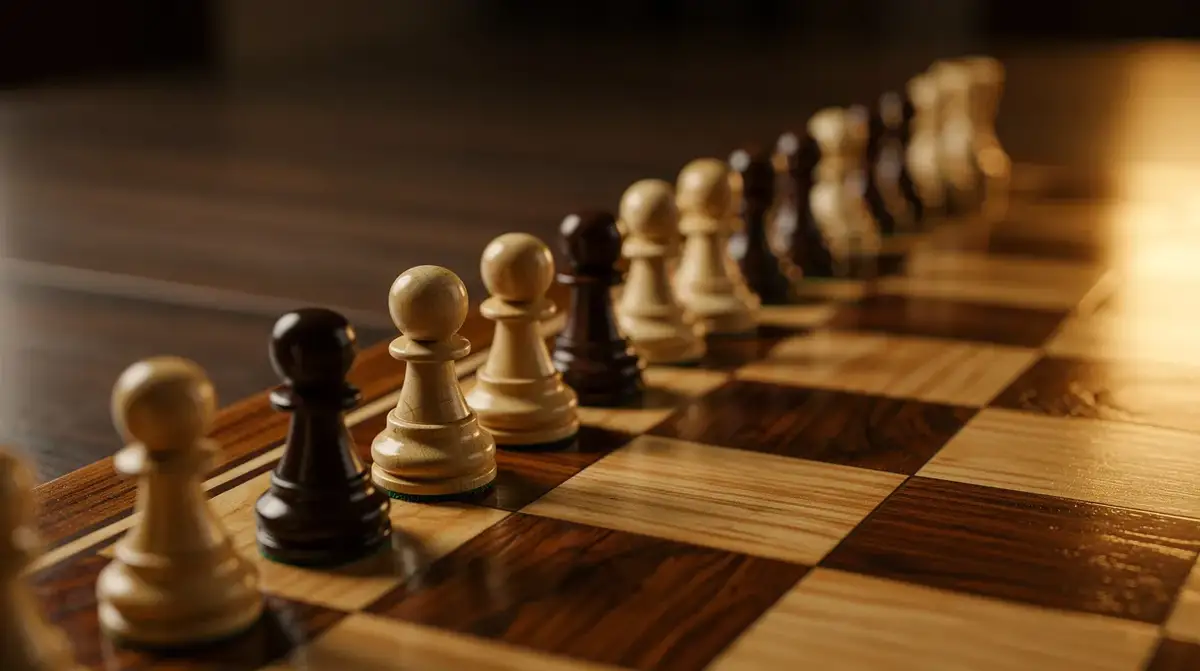
A pawn chain is a diagonal line of connected pawns where each pawn protects the one in front of it, creating a rigid, interlocking structure that controls a diagonal across the board. The most classic example appears after 1.e4 e6 2.d4 d5 3.e5 - White's pawns on e5 and d4 form a chain, while Black's pawns on d5 and e6 form a mirror chain pointing in the opposite direction.
The pawn chain has a specific anatomy that every player must understand before deciding on a plan:
- The head - the most advanced pawn in the chain (e.g. the e5 pawn). It is the strongest piece in the chain and the one that controls the most space.
- The body - the middle pawns that support the head and pass tension along the chain.
- The base - the rearmost pawn in the chain (e.g. the d4 pawn). This is the most vulnerable point because it cannot be protected by another pawn behind it.
"The pawn chain is not just a defensive wall - it is a signpost pointing directly at your opponent's weakest square. Learn to read where the chain points, and your plans write themselves."
Understanding this structure is essential before choosing a plan. One side wants to attack the head of the opponent's chain. The other side wants to attack the base. Both strategies are correct - the question is which one your position supports.
Every pawn chain has a head (the advanced pawn) and a base (the rearmost pawn). The player facing the chain must decide: attack the head to stop its advance, or attack the base to collapse the chain from underneath.
Which Openings Create Pawn Chains?
Pawn chains arise most frequently in the French Defense, the King's Indian Defense, the Caro-Kann, and several variations of the Sicilian - any opening where pawns lock diagonally rather than trade or remain mobile. Recognizing these openings is the first step toward playing with a chain correctly.
The French Defense - The Textbook Pawn Chain
The French Defense (1.e4 e6 2.d4 d5 3.e5) is the single most instructive example of pawn chain play. White advances e5 and creates a chain pointing toward the kingside. Black's chain on d5-e6 points toward the queenside. This immediately dictates where each side should attack:
- White attacks the kingside - the chain points there, so that is where White's pieces should aim. Plans include f4-f5, Nf3-d2-f1-h2-g4, and eventually opening the f-file.
- Black attacks the queenside - the chain points there. Classic plans involve c7-c5 to strike at White's d4 base, followed by Nc6, Qb6, and queenside piece activity.
This is the golden rule of pawn chains: attack in the direction your chain points, and strike at the base of the enemy chain.
The King's Indian Defense
In the King's Indian, after 1.d4 Nf6 2.c4 g6 3.Nc3 Bg7 4.e4 d6 5.e5 (or the more common central lock after 5.Nf3 0-0 6.Be2 e5 7.d5), a different type of chain forms. Here the pawns on d5-e4 for White and d6-e5 for Black create a locked center. White usually plays on the queenside with c4-c5, while Black's famous kingside attack with f7-f5-f4 is powered by the chain pointing toward White's king.
The Caro-Kann and Advance Variation
After 1.e4 c6 2.d4 d5 3.e5, a pawn chain similar to the French appears. White gets the same space advantage and kingside attacking potential, while Black aims for c6-c5 to undermine the base at d4.
Pro tip: Use our openings explorer to see exactly how often each variation of these pawn chain openings is played, how they score, and what the most common continuations look like at every level.
These pawn chain structures also connect closely to broader pawn strategy. If you want to understand how these formations fit into the bigger picture of chess planning, the guide on Pawn Structure: How to Plan Your Chess Strategy is an excellent companion read.
How Do You Attack the Enemy Pawn Chain?
You attack an enemy pawn chain by targeting its base - the rearmost pawn that has no pawn behind it to offer protection. Destroying the base causes the entire chain to collapse or become weak, stripping away the opponent's space advantage and leaving isolated or backward pawns behind.
Step 1 - Identify the Base
In a standard French Defense position, White's chain is d4-e5. The base is d4. Black's first strategic mission is c7-c5, striking directly at that base. After ...c5xd4, Black has either won a pawn or forced White to recapture with a piece, weakening the e5 pawn significantly.
Step 2 - Pile Pressure on the Base Before Striking
One pawn hit on the base is often not enough. The correct plan involves bringing multiple pieces to bear on the base pawn before exchanging:
- Place a knight on c6 to support c5 and add pressure on d4.
- Develop the dark-squared bishop to b4 or a5 to pin or threaten pieces defending d4.
- Bring the queen to b6 to target both d4 and the b2 pawn simultaneously.
- Only then execute ...c5xd4 when the position is ripe.
Step 3 - Exploit the Aftermath
When the base falls or is forced to move, the head of the chain (e5) often becomes overextended and weak. Knights can occupy squares in front of the former chain - particularly d5, which becomes a powerful outpost. Rooks rush to open or half-open files created by the pawn break.
Common trap: Many players attack the head of the chain by pushing their own pawns directly against it (for example, ...f6 against a White e5 pawn). While this can sometimes work, it often weakens your own king position and creates new targets. Attacking the base is almost always safer and more principled.
Attacking the base requires strong calculation skills. If you want to sharpen your ability to spot pawn-break tactics before they happen, practice with our chess puzzles and tactics trainer which includes pawn structure breaking exercises.
How Do You Defend and Reinforce Your Own Pawn Chain?
You defend a pawn chain by reinforcing the base with pieces, protecting the head from attacks that would undermine it, and keeping the chain's direction of pressure active so your opponent stays on the back foot. A passive defense that only reacts to threats will eventually fail.
Reinforcing the Base
If you have the chain d4-e5 as White in the French, your d4 pawn will come under fire from ...c5 almost every game. Prepare this in advance:
- Place a knight on f3 to control e5 and support d4 indirectly.
- Use the c3 square for a pawn to protect d4 (though this costs flexibility).
- Place the dark-squared bishop actively on d3, where it supports e4 and attacks the kingside.
- Keep a rook on d1 to support d4 the moment it comes under pressure.
Keeping the Head Active
The e5 pawn is your most valuable piece in the attack. Never let it become just a static object to defend. Push the initiative by:
- Supporting e5 with f4 to make the chain mobile and threatening f5.
- Using the e5 pawn to restrict Black's pieces - especially the f6 knight, which cannot easily get to its best square.
- Preparing the pawn break f4-f5 at the right moment to open lines toward Black's king.
Defending a pawn chain is not about passivity. The best defense is a constant offensive threat. If your opponent has to worry about your kingside attack, they have less time to organize the c5 base-strike that would undermine your chain.
Piece coordination is at the heart of successful pawn chain defense. The article on How to Master Piece Coordination in Chess goes deeper into how to align your pieces with your pawn structure goals.
What Are the Winning Plans When Playing With a Pawn Chain?
The winning plan with a pawn chain depends on which side of the board your chain points toward - you must attack in that direction with all your pieces, using the chain as the backbone of your offensive strategy. Passive play with a pawn chain wastes its entire purpose.
Plan A - Kingside Attack (When Your Chain Points Kingside)
This is the classic French Defense plan for White. Your chain on d4-e5 points toward the kingside. Every piece should serve the kingside attack:
- Develop the knight to d2 and then to f1-h2-g4 or f1-e3-f5, targeting f7.
- Place bishops aggressively on d3 (supporting e4) and c1-e3 or c1-d2-f4.
- Advance f4-f5, opening the f-file and creating kingside pressure.
- Castle queenside if needed to bring the rook to f1 faster and keep your own king safe.
- Look for typical sacrifices on h7 or g6 once your pieces are fully mobilized.
Plan B - Queenside Break (When Your Chain Points Queenside)
This is Black's plan in the French. The chain e6-d5 points queenside. Black's mission is:
- Play ...c5 early to strike at d4 - the sooner the better.
- Develop the queen's knight to c6, supporting c5 and threatening to invade on d4 after an exchange.
- Activate the queen's bishop - the notorious "bad bishop" of the French - via b6 or b4 or by playing ...b6 followed by ...Ba6 or ...Bb7.
- Use the queenside open files after c5xd4 to invade with rooks.
Plan C - The Pawn Break to Open Files in the Endgame
Pawn chains do not only appear in the middlegame. In endgames, a player with a strong pawn chain can use it as a space advantage to centralize the king and force a passed pawn. The technique involves:
- Centralizing the king toward the base of the opponent's chain.
- Timing the pawn break to create a passed pawn when the king is already active.
- Knowing which pawns to exchange and which to keep locked.
For more on converting endgame advantages that arise from pawn structures, take a look at our endgame training section which covers pawn endgame technique in detail.
What Is the Bad Bishop Problem and How Does It Affect Pawn Chains?
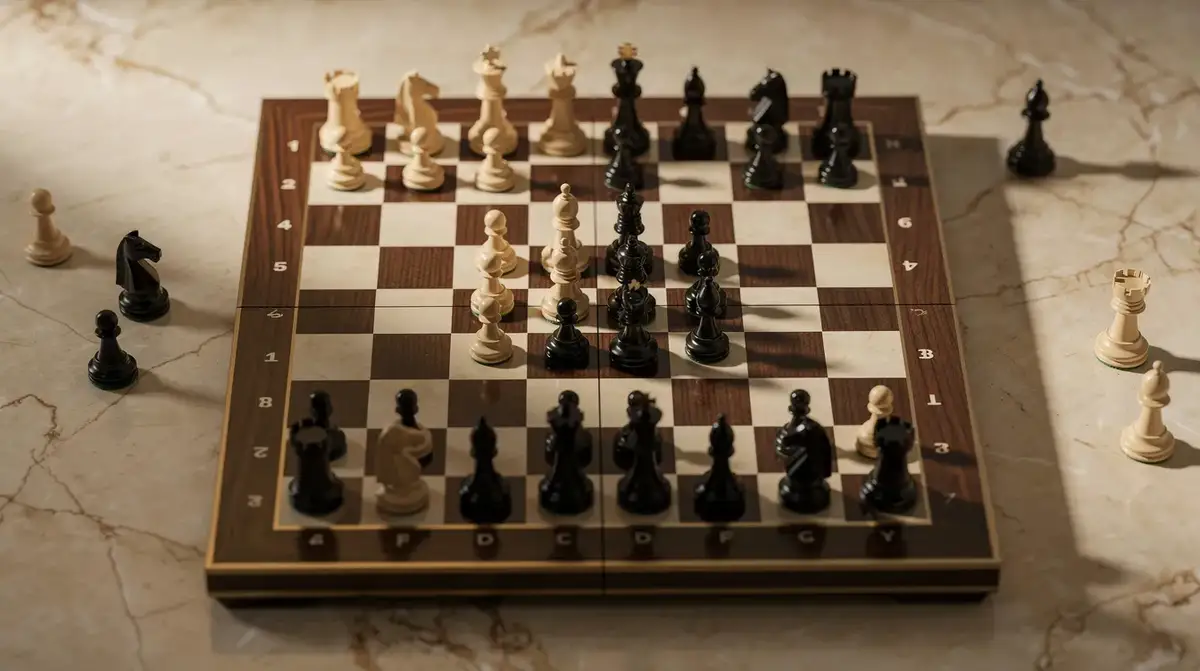
The bad bishop problem is one of the most critical pitfalls in pawn chain positions - a bishop becomes "bad" when it is hemmed in by its own pawns on the same color squares, reducing it to a passive, defensive piece that contributes nothing to the attack. In almost every pawn chain position, one player ends up with a bad bishop.
Identifying Your Bad Bishop
In a French Defense structure with pawns on e6 and d5 for Black, the light-squared bishop (the c8 bishop) is trapped behind its own pawns. It cannot develop easily and often spends the whole game sitting uselessly on d7 or e8. This is one of the structural costs Black pays for the solid d5-e6 chain.
White has the opposite problem - the dark-squared bishop (c1) is hemmed in by the d4 pawn. However, White's light-squared bishop on f1 is free to become a powerful piece on d3.
How to Solve the Bad Bishop Problem
- Exchange it - look for ways to trade your bad bishop for a good enemy piece, preferably a knight or the opponent's good bishop.
- Activate it outside the chain - Black in the French can play ...b6 and ...Ba6 or ...Bb7, placing the bishop outside the pawn chain via a6 or b7.
- Restructure the pawns - if you can move one of the pawns that block your bishop (e.g. ...e5 in some French positions), you free the bishop at the cost of structural changes.
Pro tip: When your bishop is bad, think of it as a "tall pawn" - use it to protect squares rather than to attack. Meanwhile, your knights thrive in locked pawn structures, so prioritize knight maneuvers when your bishop is bad.
The challenge of the bad bishop connects directly to weak color complexes. When you have a bad light-squared bishop, your light squares become permanently weak. The guide on How to Play Chess With Weak Color Complexes and Win explains how to handle this at a deeper level.
How Do Pawn Chain Structures Evolve Into the Endgame?
Pawn chain structures in the endgame favor the player whose chain is pointing forward and whose king can reach the critical squares more quickly - which means the player with the more mobile or better-positioned chain often wins the endgame conversion. Understanding this helps you plan trades in the middlegame wisely.
When Pawn Chains Are Good in the Endgame
A pawn chain that has survived to the endgame is often strong because:
- The head pawn controls key squares your king can use to invade.
- The chain restricts the opponent's king from entering your half of the board.
- A well-timed pawn break can create a passed pawn that decides the game.
When Pawn Chains Become a Liability in the Endgame
A rigid chain can also be a weakness because:
- If the chain cannot advance and cannot be broken, it creates permanently weak squares around the base pawn.
- The king of the side with the chain may find it hard to penetrate - the chain blocks its own king too.
- Pieces defending a static chain have no active play and get outmaneuvered by a dynamic opponent.
Common trap: Players often keep a rigid pawn chain locked for the entire endgame, assuming it is strong. If you cannot use the chain to invade or create a passed pawn, consider breaking it voluntarily to create dynamic play - static advantages decay in the endgame if the opponent's king is better placed.
For a complete toolkit of endgame technique, the blog post on How to Win Chess Endgames: Essential Techniques is a must-read alongside this guide.
How Can You Practice Pawn Chain Strategy Effectively?
You practice pawn chain strategy most effectively by playing openings that create pawn chains deliberately, analyzing your games to identify where your chain plans went wrong, and drilling pawn structure puzzles that isolate the specific decisions involved in base-attacks and kingside breaks.
Play the French Defense Regularly
There is no better teacher for pawn chain concepts than the French Defense. Play it repeatedly from both sides - as White after 3.e5 Advance Variation, and as Black. You will quickly internalize the plans, the bad bishop problem, and the race between White's kingside attack and Black's c5 break.
Use an AI Training Bot With a Specific Style
Training against a bot that deliberately plays pawn chain positions from both sides helps you see the patterns repeatedly. Our human-like chess bots are trained on real human games and include personalities like the Practical Hunter and Attacking Bot that regularly employ pawn chain setups - giving you realistic practice against human-style planning rather than engine randomness.
Analyze Your Games After Every Session
After playing a game with a pawn chain, use a game analyzer to see exactly when your chain plan broke down - did you attack the wrong side? Did you neglect to reinforce the base? Did your bad bishop stay passive all game? Our game analyzer classifies missed tactics and structural errors so you can spot exactly where your pawn chain management went wrong.
Pawn chain mastery comes from repetition in specific positions, not from general chess improvement. Pick one opening that creates a pawn chain (such as the French Defense Advance Variation), play it dozens of times, and review each game. Pattern recognition in these positions builds faster than almost any other training method.
If you want structured improvement across all these strategic areas, the chess learning course for puzzles and endgames combines daily puzzle sets with endgame technique training in a format designed for players in the 800-1800 range - exactly the rating zone where pawn chain understanding makes the biggest difference.
For broader strategic development that builds on pawn chain concepts, you may also find value in How to Play Positional Chess When No Tactics Exist and How to Play Chess With a Space Advantage and Win, both of which deal directly with the long-term advantages that pawn chains create.
Frequently Asked Questions About Pawn Chains
Is the pawn chain better for White or Black?
Neither side has an automatic advantage - it depends entirely on the specific position and whether each side executes their correct plan. In the French Advance, White gets space but must defend the base against c5; Black gets a solid structure but must fight to activate the bad bishop. The side that executes their plan faster and more precisely wins.
Should I always try to break the enemy pawn chain?
Not always. Sometimes the correct strategy is to blockade the chain head with a knight (for example, placing a knight on d5 in front of an e5 chain) and outplay the opponent positionally rather than forcing a pawn break. Assess whether you can outmaneuver the chain or whether a direct break is more efficient.
What is the difference between a pawn chain and hanging pawns?
Hanging pawns (such as pawns on c5 and d5) are side by side without pawn support, creating a different dynamic - they are mobile but potentially weak. A pawn chain is diagonal and each pawn defends the one in front. For a deeper look at hanging pawns, see How to Play Chess With Hanging Pawns and Win.
Can I use pawn chain concepts at the beginner level?
Absolutely. Even at 800-1000 rating, understanding that you should attack in the direction your chain points will immediately improve your plans. You do not need to calculate deeply - just place your pieces toward the side your chain points, and attack the base of the enemy chain with c5 or f6. Start with the beginner chess school if you are new to these structural ideas.
How do pawn chains relate to other pawn weaknesses?
Pawn chains often create other pawn structures when they break down - backward pawns, isolated pawns, and doubled pawns can all result from a collapsing chain. Understanding each of these structures helps you plan before and after the chain breaks. See How to Play Chess With a Backward Pawn and Win and Isolated Pawns in Chess: Turn the IQP Into a Weapon for the full picture.
Pawn chains are a cornerstone of chess strategy from the beginner level all the way to grandmaster play. Attack in the direction your chain points. Reinforce the base before the enemy strikes it. Keep your bad bishop active or trade it early. Use the chain to dictate where the game is played. Now put these concepts into practice - play the French Defense, study the plans, and use our tools to analyze where your chain strategy wins and loses. The improvement will come faster than you expect.